|
 |
|||||||||||||||
|
About The Artist
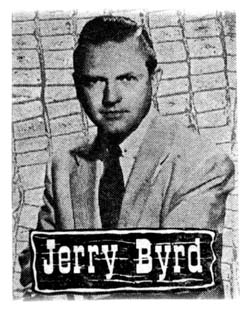
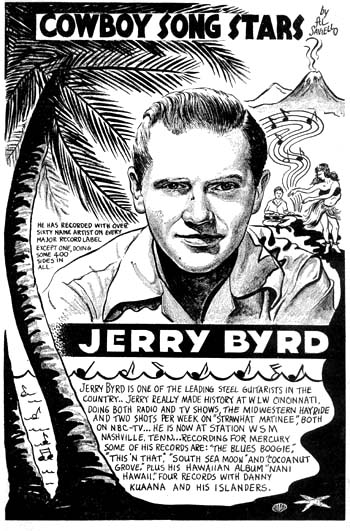
He was the first child of Harley and Lauretta Byrd, born in Lima, Ohio. He graduated from Lima Central High School in 1939. He showed a strong love of music, particularly the Hawaiian "Steel" guitar after hearing one played for the first time at a traveling tent show around 1932. In an interview with Rick Chatenever of the Maui News on October 11, 1991, Jerry described seeing and hearing the steel guitar for the first time in that tent show as a 12-year old boy. He listened to the music and was hypnotized by it. And that attention to that sound stayed with him all through his life.
Jerry said in that interview of the tent shows, "They were much like circuses. They would spend one or two days in town and then move on. If you missed it, you had to wait a year. One of my schoolmates, he came from a wealthy family and said he would pay my way. It cost a dollar. I had never seen a dollar before." Jerry then aimed to learn to play the steel guitar, but quickly surpassed his teachers. He said the guy who taught him played "Home an the Range." In fact, this was during a time when there was a big fascination with the Hawaiian music and culture in the United States at the time. Every radio station seemed to have something that was Hawaiian at the time in the 30s and 40s. For Jerry, he paid for instrument transcribing at the "Honolulu Academy of Music" in Lima, Ohio. He was playing professionally by the time he was 15. Jerry was quoted, "I played beer joints for $1 a night." He was also doing his own "research" into the steel guitar at the time. "There were no teaching materials. So I started out on my own, experimenting with tunings. I was way ahead of the game."
Many steel players have claimed they used the C-6th long before they ever heard of Jerry. But, when they were asked specifics such as when they started using the tuning, they cannot verifiably show they were using it before 1939. In fact, most were not yet born or were only 5-10 years old. Jerry can verify his claim, he has that original recording in his possession. There was little else to do during the deep depression years of the 1930s, Jerry turned to the Hawaiian steel guitar instrument and gave it his complete attention. When he graduated, from high school, Jerry left Lima, Ohio to start his musical career. He began in Kentucky when John Lair talked him into joining the Renfro Valley Barn Dance back in the 1930s, possibly around 1938 (a Country Song Roundup article in 1950 indicated Jerry had been on the radio for 12 years by then). While he was in Renfro Valley, he worked in the music library during the week. The Renfro Valley Barn Dance achieved a bit of fame itself, being broadcast at one time on the NBC, CBS and Mutual radio networks. Illness struck Jerry in 1941 when he contacted pneumonia which nearly took his life. The disease prevented him from participating in any military service during World War II. He returned to his home in Lima and following a long recuperation period he returned to the Renfro Valley Barn Dance where he worked until 1942. In 1942, he moved to Detroit, Michigan, where he appeared on radio station WJR for over two years. His career saw him as a member of Ernest Tubb's band the "Texas Troubadours" for about three months; long enough to go to Hollywood and be a part of the movie, "Hollywood Barn Dance". Later on, he joined the Cumberland Valley Boys which was the group behind Red Foley. Jerry then joined the world famous "Grand Ole Opry" in Nashville, Tennessee, in 1944/45. It was during this time that his unique playing style was first heard on commercial recordings with nearly all the top country singers of that era. Jerry quickly became the most sought after "side" man in the recording industry, doing hundreds of sessions with singers from the country and pop segments of the business. In 1948/49, he moved to Cincinnati, Ohio, to join the popular WLW Midwestern Hayride where he gained his first national television exposure. At that time, he was a part of the Pleasant Valley Boys group, which included Red Turner, Zeke Turner and Louie Innis. While on WLW, he was also on the "Strawhat Matinee" that aired on the NBC network, too. Later on, he became a part of George Morgan's "Candy Kids" as part of the robin Hood Flour Shows that were broadcast over the CBS radio network. He was only a temporary replacement with George Morgan's group at the time as the original steel guitar player had gone into the Army. While he was in Nashville, he had a show that aired on Friday nights at 7:15 EST that he shared with Chet Atkins called "Two Guitars". In a Country Song Roundup article of 1954, they said he had recorded with The Harmonicats, Rex Allen, Louis Innis, Chet Atkins, the Davis Sisters, Homer and Jethro, Guy Mitchell and more. Jerry continued to do more recording sessions plus daily radio and television shows. He returned to Nashville in 1952 and remained there for twenty years where his heavy work schedule continued. Jerry notes in a radio interview with Canadian Broadcasting's Laurie Mills in about 1973, that the first records he made of any consequence were with Ernest Tub. He had been working at a radio station in Detroit, Michigan at the time and that job had ended and then he got a call from Ernest Tubb. He said he was playing the same type of fills he had been playing for years and "...all at once I was discovered." He then started working with Red Foley, then recorded on his own with Mercury in 1949.
During that circa 1973 interview, Jerry mentions: "I listened to the Hawaiians because they were really the only ones who were playing the steel guitar at that time. Dick McIntyre was my particular favorite although there were so many great ones .. Andy Iona, Sam Koki, Sol Ho'oppi'I ... all of them contributed to steel guitar. A lot of the kids like me that were learning to play - you couldn't play Hawaiian music in the middle of Ohio so you play the next thing to come along which was country music. I know Joaquin Murphy out in California picked up a lot of his stuff from Sol Ho'oppi'i. Roy Wiggins got a lot of his stuff from Hawaiians - that was the only place you heard it."
Later on in the interview with Laurie Mills, he mentions the impact of being a session musician or being located in one area such as Cincinnati or Detroit where you don't get out of the state much and not doing much road work. He felt he didn't get the chance to experiment as much as say a person such as Curley Chalker who was working quite a bit in Las Vegas at the time to work in different techniques. He said he started working with a "...five piece band just to do that - to get to play something different and be able to experiment more." Another unique aspect of Jerry Byrd's steel guitar sound is the instrument type he chose to play throughout his career. In the Maui News article, it mentions that Byrd had always stayed up with the latest technology. But he found that he resisted the next development in the steel guitar's evolution.
"I never went to pedal steel," he said. "I gave it a lot of thought, but I had started going on my own as a soloist. I realized I had an identity. I would lose followers if I changed."
He called the twangy instrument, so essential to the honky tonk sound, "the great equalizer. If you didn't have the talent in your left hand, your feet did it for you." Jerry said, "I never changed. That was the best decision I ever made." In the interview with Laurie Mills, Jerry mentions he first saw a pedal steel guitar in 1939. Back then he said, they weren't as sophisticated as they are now with the instruments; they had ingenious ways to pull the strings, but they didn't seem to work and the guitars were forever out of tune. That made him think he wasn't going to change unless he saw some big improvements. It wasn't until 1949 that he saw a good version of a pedal steel. Ernest Tavares was playing it, who was with Harry Owens at the time. Jerry thought Ernest's pedal steel was good, but by that time, Jerry had been recording on his own and had developed a unique style. He had a big fan club back then he said. He asked them - should he move to the pedal steel? They told him, if they wanted to hear the pedal steel guitar, they would buy those records, so his fans told him to stay the course.
"I played a trade show and some boy came up to me and saw my little ol' black Bakelite Rickenbacker that's in the Hall of Fame. He said "Is that the guitar you use all the time?" and I said "Yeah". I was playing in the Rickenbacker guitar company's suite at the show. I said "Why?" and he said "Well, you play a lot of stuff so you must play a pedal guitar. I've heard that you've got one at home you keep in a closet and only bring it out for recording sessions". (laughs) I said "No, this is what I play. I'm not up here selling' guitars. They pay me to come up and play and that's what I'm doing". I don't think he ever did believe me." Jerry went on to explain how he was able to mimic the sounds that a pedal steel might generate in that interview.
"I did an album called "Admirable Byrd" and I did a lot of pedal sounds in there ... not as good as the pedal guys could do it but it was that sound and it was still different. I wrote a lot of the tunes to show what you could do without pedals in an E9th tuning. I got a lot of mail ... one of the songs is "I'll Be All Smiles Tonight" and I do a lot of bar slant work, you know, and a lot of people still don't believe I did it without a pedal guitar but I did. To me it's kinda silly. Why would I lie about it if I did play pedals! I'd tell 'em." One of the things Laurie Mills brought up during that circa 1973 interview was Jerry's contribution to what is called "The Nashville Sound". He asked whether Jerry and others knew what they were creating at the time. "No, and nobody else knew either, It was just something that evolved. At that time for recording sessions, there were only 5 or 6 guys doing the majority of 'em ... Chet Atkins and myself and a few others. Back in those days, and Nashville still practices, (there was) a kind of an interest in what the singer is tryin' to do. They'll go to extra lengths to see that they're satisfied. Which is good business. It's always been that way. Back when we started we didn't watch the clock, we were interested in recording four sides, having it good and everybody really pitchin' in. When the New York singers and all the pop singers started coming to Nashville, that's the thing that impressed them the most ... the desire on the part of the musicians to get a good record for them. So that's how Nashville got started and I think that's how they still practice. I hope so." One memorable session was the one in Cincinnati, Ohio with none other than Hank Williams when he finally got the okay from Fred Rose to record "Lovesick Blues". Jerry was a part of that session as were Zeke Turner on lead guitar, Louis Innis on rhythm guitar to reinforce Hank's playing. Tommy Jackson was on fiddle. And a WLW announcer by the name of Willie Thall played bass. It was around the time of the recording ban and Fred Rose didn't exactly care for the song. Jerry had been working with Turner on a previous Ernest Tubb session that included "Waiting For a Train" and with little time to try anything else, they replicated that sound a bit with Hank's song. Jerry said they did two cuts. And he said he told Hank that was the sorriest thing he ever did hear. But Hank was defensive a bit and mentioned that they may put that song on a flip side or something. Jerry and the rest of the crew were a bit 'dismayed' that 'anything as sorry as that could be a hit'. But as legends go, history shows that "Lovesick Blues" became Hank Williams' biggest hit and when he performed it on the WSM Grand Ole Opry, it brought the house down. But Nashville wasn't to be Jerry's last stop or home. In that 1991 interview with the Maui News, Jerry reveals how it came to be that he moved to the Hawaiian islands. "Hawaiian style - that's where my heart was always at. I talked to Sonny Kamahele, he said, come, on over here. You belong with us, anyway."
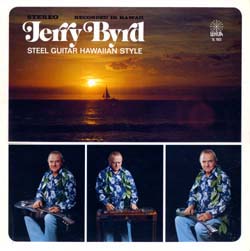
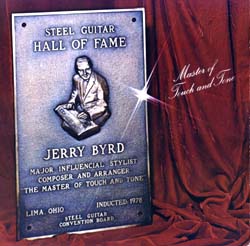
Eventually, Jerry took Kamahele's advice and moved there 1971. Jerry said his first job was with Kamahele, stating that he was playing two weeks after he had arrived. "I didn't want to do shows - I wanted to get a couple of guys and go play the clubs and just play." Jerry's love for the steel guitar and Hawaiian music are reflected in his many accomplishments and the deserved recognition he has received over the years. The first steel guitar and amplifier he used can be found on exhibit in the Country Music Hall of Fame in Nashville. Jerry was the first inductee into the International Steel Guitar Hall of Fame in St. Louis, Missouri in 1978. Between 1978-1998, he performed over 35 times in Japan and played two concerts in Australia and one in New Zealand. Throughout his career, Jerry has always took the time to show others or teach others the rudiments of Hawaiian steel guitar playing. Even back in 1950, he signed up with the Robbins-Miller-Feist publishing company to publish a set of instructions for playing the steel guitar. Back then the hope was to include a correspondence course as well that would be distributed nationally. Later, when he moved to Hawaii, he wanted to teach the native Hawaiian students the musical theory of the Hawaiian steel guitar which he had become associated with so they could carry on the island's musical legacies. Jerry talked of his methods and ideals for teaching his students Hawaiian steel guitar playing in that 1973 interview: "What I do with my boys - I have them from 11 years old up to college age what I've found by trial and error - talking about someone who has no knowledge of steel guitar ... I started 'em out with 6 strings. The 1st thing that they learn is the left hand ... how to hold the bar, how to move it, how to slant it, forward slant 1st, reverse slant later. Then we start with a simple "A" tuning - EC#AEC#A - for two reasons: one you're dealing with new ears and it's easier for them to hear a guitar tuned in thirds . ... then we move to E major which eliminates some of the slant bar work of A tuning and makes it a little easier to play—which is really the reason these tunings were discovered. We have 6 or 8 lessons in E tuning, then E7th, then C#m which is a combination of A tuning and E tuning. They're able to get more chords and it starts sounding more like music to them. Then we go into C6th tuning - the final tuning that I teach. There you've got all your chords - at least in triads, major , minor, diminished , augmented, things like that. Then when they're done with that, if they want to get into note reading, they can - I leave it optional. Jerry has composed over 35 instrumentals and has written several instructional books and 199 arrangements for the steel guitar. He has also recorded an instructional video tape. Jerry's main professional involvement today is teaching private lessons in Hawaii to ensure a continuing life for the instrument in its native environment. To this end, he has taught over 4,500 private lessons between 1980 and 2001. Jerry's contribution to Hawaii and its music was acknowledged by Hawaii's representative on April 12, 1989 in the Congressional Record of that date, which reads as follows:
PRAISING JERRY "MANU" BYRD Jerry was about 5 foot 8 inches tall and around 143 pounds back then. He married a gal named Thelma and they had two girls, Lani Jo and Luana June. In 1950, Jerry did his first solo steel guitar recordings under his name. Before he finished, he had recorded over 280 sides and had 25 albums released on eight labels. The following is a list of the singles that were issued on 78rpm. By no means are they a complete listing of his life's works. We cannot list the recordings he appeared on nor the subsequent albums he made later in his career as part of this site's scope, but these will show you a part of his legacy. The albums and CD's that came later also capture his legendary sound and style. Credits & Sources
Sound Sample—(YouTube Video Format)
|
| Printer Friendly Version |
|
Recordings (78rpm/45rpm)
| |||||||||||||||||||||||||||||||||||||||||||||||||||||||||||||||||||||||||||||||||||||||||||||||||||||||||||||||||||||||||||||||||||||||||||||||||||||||||||||||||||||||||||||||||||||||||||||||||||||||||||||||||||||||||||||||||||||||||
Hillbilly-Music.com
Yes, Hillbilly Music. You may perhaps wonder why. You may even snicker. But trust us, soon your feet will start tappin' and before you know it, you'll be comin' back for more...Hillbilly Music.
Hillbilly-music.com ...
It's about the people, the music, the history.
|
Copyright © 2000—2023 Hillbilly-Music.com
|
||||
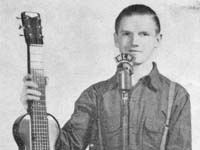 Gerald Byrd became known as Jerry Byrd, the legendary Hawaiian steel guitar
master. In fact, his plaque in the Steel Guitar Hall of Fame proclaims
him to be "The Master of Touch and Tone".
Gerald Byrd became known as Jerry Byrd, the legendary Hawaiian steel guitar
master. In fact, his plaque in the Steel Guitar Hall of Fame proclaims
him to be "The Master of Touch and Tone".
 How far ahead of the game was he in his tunings and his styling? Let's take a look
at his history. Jerry pioneered several things in the history
of steel guitar one being a tuning of which there are several.
He introduced what he called the "C-6th" tuning and did so in
1939 publicly. It revolutionized the steel guitar as an instrument.
He was recorded playing in this tuning at Ron Dearth's studio
in Lima, Ohio on February 19, 1939. This indicated
Jerry was playing in this tuning as early as 1938 when he was only
18 years old.
How far ahead of the game was he in his tunings and his styling? Let's take a look
at his history. Jerry pioneered several things in the history
of steel guitar one being a tuning of which there are several.
He introduced what he called the "C-6th" tuning and did so in
1939 publicly. It revolutionized the steel guitar as an instrument.
He was recorded playing in this tuning at Ron Dearth's studio
in Lima, Ohio on February 19, 1939. This indicated
Jerry was playing in this tuning as early as 1938 when he was only
18 years old.
 Jerry mentions that the first country steel guitar player that made an
impact on him was a fellow that was a part of the legendary western swing
band lead by Bob Wills - Leon McAuliffe. He said in that 1973 interview
that he went to see a movie with Bob Wills about four times just to see
Leon play that one chorus of Ida Red. He said his style leant itself to
country music as it was back then. But in 1973, he didn't know how his sound
would fit in with the music of the day. He said the Red Foley ballads
back then such as "Blues In My Heart" were the type of songs he enjoyed.
Jerry mentions that the first country steel guitar player that made an
impact on him was a fellow that was a part of the legendary western swing
band lead by Bob Wills - Leon McAuliffe. He said in that 1973 interview
that he went to see a movie with Bob Wills about four times just to see
Leon play that one chorus of Ida Red. He said his style leant itself to
country music as it was back then. But in 1973, he didn't know how his sound
would fit in with the music of the day. He said the Red Foley ballads
back then such as "Blues In My Heart" were the type of songs he enjoyed.
 In the Mills interview, Jerry relates a tale of when he played
at a trade show.
In the Mills interview, Jerry relates a tale of when he played
at a trade show.