|
 |
|||||||||||||||
|
About The Group
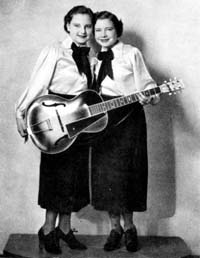
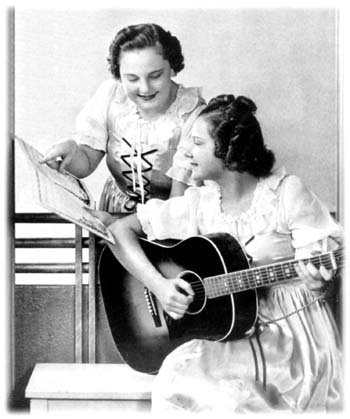
During the 1930s. as this country struggled against the shackles of the Great Depression rural youth left their farms in droves seeking employment and other opportunities in the nation's cities. In search of the good life and urban sophistication, many strove to divest themselves of all reminders of their agrarian heritage. Among this host of migrating youth were Mary Jane and Carolyn DeZurik, two young women who had been born and reared on a farm in Minnesota. Unlike scores of their contemporaries, however, they did not turn their backs on their pastoral past. In fact, they took a part of their rustic raising with them and parlayed it into careers that would make their names and talents known to millions of radio listeners, record buyers, stage-show audiences, and movie goers across the country. Mary Jane and Carolyn DeZurik were born on a farm six miles east of Royalton, Minnesota. in the center of the state and a mere hop, skip, and jump from the Mississippi River. Mary Jane was approximately two years older than Carolyn and, like their four sisters and one brother, were taught by their parents, Joe and Mary DeZurik, to perform all the chores necessary for survival in a rural environment. They milked cows, tended the family garden, cleaned the barn, shucked grain, stacked hay, canned fruits and vegetables, and helped keep house. But all was not drudgery around the DeZurik home place. The family somehow found time for the music that they all loved and most were accomplished at performing. The father of the DeZurik children played fiddle for local barn dances, son Jerry played accordion and guitar and sang and five of the six girls were also singers and guitar players. But it was Mary Jane and Carolyn who persisted in honing their talents to a professional edge to put the Dutch-derived name DeZurik before the public. To roost farm folks the sounds of their domesticated animals are heard as demands for food and other ministrations to physical needs. Most of the DeZurik's farmer neighbors listened to the sounds of wildlife for cues to locating game that could be converted into food for the family table. Mary Jane and Carolyn, however, were on a different wave length. In the bleat of the calf, the cackle of the hen, the howl of the wolf, and the warble of the bird they, like the storyteller in "The Song of Hiawatha," heard an inspiring natural music. These varied animal sounds provided them with ideas for yodels and trick vocalizations that they incorporated into their singing to produce a unique style that set them apart from other vocalists. Their novel harmonies attracted the attention of entertainment entrepreneurs searching for the elusive "something different" that could be developed into a successful show business career. The DeZurik sisters received their first stage experiences by entertaining—and usually winning—amateur contests in central Minnesota. Their prize for winning one contest was two appearances on radio station KSTP in St. Paul. In 1936, after winning another contest, they were invited to appear at the Morrison County Fair in Little Falls, Minnesota. Carolyn remembers that "It just so happened that a group of WLS National Barn Dance entertainers were also appearing at the fair with one of their shows." After watching and listening to the DeZurik sisters, George Ferguson of the WLS Artists' Bureau asked them to appear on the Saturday night National Barn Dance radio and stage show. They made their Barn Dance debut on October 17, 1936. A month later, on November 19, they signed the contract with WLS that made them full-time employees of the station.
It would not be long, though. before they would have a change of mind. Ralph "Rusty" Gill, staff guitarist and vocalist with the Hoosier Sod Busters had been working for the station a couple of years when the DeZurik sisters joined the WLS roster of entertainers. "It was on one of the WLS road shows at a county fair where I first met Carolyn and Mary Jane DeZurik." he recalls. "I worked with and along side of them for months, before I realized that I was keeping my eyes on Carolyn. So were other guys, and Mary Jane was keeping her eyes on me, watching out for the younger sister. After two years of working side-by-side with the girls, I finally worked up enough courage to ask Carolyn to marry me. To my surprise, she answered with a big, 'yes'. We were married September 1, 1940." Less than a month later, on September 29, Mary Jane married Augie Klein. a WLS staff accordionist. Exposure provided by WLS and the National Barn Dance opened additional career doors for Mary Jane and Carolyn DeZurik. In 1938 they signed a contract to record for the Vocalion label. They recorded six songs:
A month after their marriages the DeZurik sisters were off to Hollywood to star in the Republic Pictures movie "Barnyard Follies" which also featured June Storey, long-time leading lady in Gene Autry westerns; and Pappy Cheshire, a country music radio personality at KMOX in St. Louis. The songs Mary Jane and Carolyn sang in the movie were:
Perhaps the most significant break in the DeZurik Sisters' early career came in 1937 when they were hired by Purina Mills to appear regularly on the transcribed "Checkerboard Time" radio show that advertised Checkerboard chicken feed and other Purina products. Carolyn remembers how she and Mary Jane were selected for the job. "Two talent scouts from Purina Mills came to the WLS National Barn Dance on a Saturday night to hear us in person." she relates. "Afterwards they came backstage to talk to us. The following Monday we went to a recording studio and made a record for them to take back to Purina Mills who listened and hired us. The reason the scouts came to the Barn Dance, they had heard us do "My Little Rooster," and they thought it would make a terrific trademark for their show." Because of contractual agreements between the DeZurik Sisters and WLS, the Purina folks renamed their new artists the Cackle Sisters. Over the next several years, according to Rusty Gill, the transcriptions of the Checkerboard Time were heard on radio stations in all of the then forty-eight states. Other artists appearing on the shows included Fran Allison, the Maple City Four, the Cass County Kids, the Swanee River Boys, and Otto and the Novelodians. Among the programs' emcees were Chick Martin, Jack Holden, and Jack Stillwell. In anticipation of new arrivals in their households Carolyn and Mary Jane temporarily stopped performing in 1940, except for their appearances on transcriptions and commercials. Later in the year, Carolyn and Rusty became the parents of a son. Donald Alan, and Mary Jane and Augie Klein's daughter, Janice Marie, was born. In 1943 Rusty and Augie were drafted, and for the next three years military duty - much of it overseas - kept them away from their families. During Rusty's absence Carolyn edged past more than 40 other hopefuls to win an audition for the Sonja Henie Ice Review. During her stint with the Review, Carolyn sang and yodeled in several segments of the show while the former Olympic skating champion displayed her talents on the rink. "The most exiting part of the show for me," Carolyn reminisces, "was the opening. The announcer came on with, 'It's the Sonja Henie Show.' The spotlight opened on me yodeling and then fanned out to Sonja and the entire cast."
In 1944 Purina Mills again came calling on the DeZurik Sisters. This time the manufacturer of animal rations wanted Mary Jane and Carolyn to reprise their act as the Cackle Sisters for appearances on stage and radio transcriptions with a rising country music star named Eddy Arnold. Mary Jane was enticed out of retirement, and once again, the DeZurik/Cackle Sisters found themselves involved in a full schedule of entertaining that included regular appearances on the Grand Ole Opry, road tours with Eddy Arnold and other Opry stars, and Checkerboard Funfest transcriptions that were heard on radio stations around the country. During this time Mary Jane and Carolyn continued to make their homes in Chicago, a decision that necessitated a weekly train commute between the Windy City and Nashville so they could fulfill their Opry obligations. Thus they became the first women to achieve stardom on both the National Barn Dance and the Grand Ole Opry. Upon his discharge from the military in 1946, Carolyn's husband, Rusty Gill, returned to WLS and the National Barn Dance, reclaiming his place as a member of the Prairie Ramblers which, at the time, also included Chick Hurt, Jack Taylor, Alan Crockett, and Bernie Smith. The following year the DeZurik Sisters also returned to WLS, but now the act consisted of Carolyn and another sister, Lorraine. After she and her family were in a serious automobile accident in 1947, Mary Jane had decided to retire from show business. In 1949 the Prairie Ramblers and the DeZurik Sisters left Chicago for jobs at WLW radio and WLW-TV in Cincinnati, Ohio. They appeared regularly on the Midwestern Hayride, a Saturday night barn dance type show carried by the National Broadcasting Company's television network. Their fellow performers at WLW included Ernie Lee, Judy Perkins, and Kenny Roberts. After two years in Cincinnati the Prairie Ramblers moved to a new job at WHIO-TV in Dayton. Ohio. By now Lorraine had retired and Carolyn had become the female vocalist with the Prairie Ramblers, a position that had been vacant since Patsy Montana had left the group some ten years earlier. In 1951 Carolyn DeZurik and the Prairie Ramblers returned to Chicago and took jobs at WBKB-TV (now WLS-TV)(Channel 7), the city's television outlet for the ABC network. They were given featured billing on a daily show called "Chicago Parade". During the next several years they were involved in a wide variety of television and stage shows including the TV show "Crazy Acres" on which, according to the local press, they provided "lots of music and dancing and entertainment (country style, of course)." In 1956. during a revival of interest in polka music, Carolyn and the Prairie Ramblers made the most drastic change of their careers. They dropped the country and western songs from their repertoire and replaced them with new material like "Swiss Kiss Polka" and "Grey Horse Polka." They swapped their cowboy hats and boots for Bavarian costumes, teamed up with Stan Wolowic, changed their name to the Polka Chips with Carolyn DeZurik. and became one of the polka sensations of Chicago. For the next two years they entertained television audiences with their interpretations of the music which, in the words of one writer, "crystallized in Chicago in the 1950's [and] swept fans and bands across the land."
From 1956 through 1963, Carolyn supplemented her entertainment duties with a commercial commitment with Busch Bavarian Beer. She was the company's yodeling trademark on transcriptions made at Universal studios in Chicago and in St. Louis. Jamie and the Jays were her vocal background group. When Polka-Go-Round went off the air Carolyn retired from the entertainment business, bringing down the curtain on the varied and rewarding career of the DeZurik Sisters that had started in Royalton, Minnesota some 30 years before. Mary Jane died in 1981, and Lorraine had earlier married and moved to Washington state where she continues to live. Today Rusty and Carolyn are enjoying their retirement in the Chicago area while keeping in contact by telephone and letters with many of their former fans and colleagues. Timeline and Trivia Notes Group Members included:
Other Notes
Credits & Sources
Appearance History This Month
Read More About The Group
| ||||||||||||||||||||||||||||||||||||||||||||||||||||||||||||||||||
Hillbilly-Music.com
Yes, Hillbilly Music. You may perhaps wonder why. You may even snicker. But trust us, soon your feet will start tappin' and before you know it, you'll be comin' back for more...Hillbilly Music.
Hillbilly-music.com ...
It's about the people, the music, the history.
|
Copyright © 2000—2023 Hillbilly-Music.com
|
||||
 SAME FACES, DIFFERENT NAMES
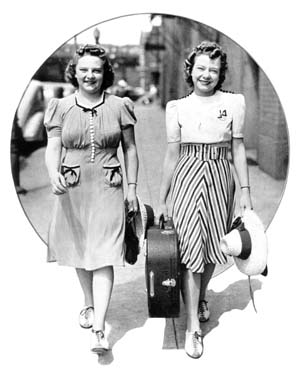 Mary Jane and Carolyn were instant hits with WLS listeners
and the audiences that heard them when they made personal appearances
with WLS road shows. The publicity people at WLS wrote about them
frequently for The Prairie Farmer the newspaper that owned WLS and
Standby, the station's fan magazine. "They specialize in trick yodels
including a Hawaiian yodel, the cackle trill, German, Swiss and triple
tongue yodel." readers were told in one article. "They are clever
at imitating the sounds of musical instruments such as the Hawaiian
guitar, trumpet, musical saw and mandolin. They have memorized more
than two hundred and fifty songs." In another article, the writer
gave readers a description of the sisters, "Caroline [This spelling of
Carolyn's name was frequently used.] is five feet and one inch tall
and has blue eyes and light brown hair. Mary Jane is just five feet
tall and looks much like her sister, with the same color hair and
eyes. Neither girl is married and both insist they have no intentions
of wearing orange blossoms soon."
Mary Jane and Carolyn were instant hits with WLS listeners
and the audiences that heard them when they made personal appearances
with WLS road shows. The publicity people at WLS wrote about them
frequently for The Prairie Farmer the newspaper that owned WLS and
Standby, the station's fan magazine. "They specialize in trick yodels
including a Hawaiian yodel, the cackle trill, German, Swiss and triple
tongue yodel." readers were told in one article. "They are clever
at imitating the sounds of musical instruments such as the Hawaiian
guitar, trumpet, musical saw and mandolin. They have memorized more
than two hundred and fifty songs." In another article, the writer
gave readers a description of the sisters, "Caroline [This spelling of
Carolyn's name was frequently used.] is five feet and one inch tall
and has blue eyes and light brown hair. Mary Jane is just five feet
tall and looks much like her sister, with the same color hair and
eyes. Neither girl is married and both insist they have no intentions
of wearing orange blossoms soon."
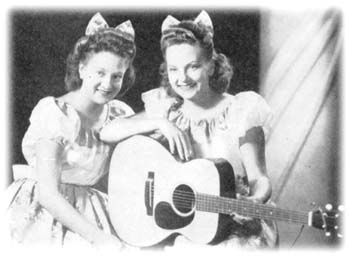 And following its release, the DeZurik Sisters toured with the
movie on a promotional jaunt that took them into new territory
and introduced them to new audiences.
And following its release, the DeZurik Sisters toured with the
movie on a promotional jaunt that took them into new territory
and introduced them to new audiences.
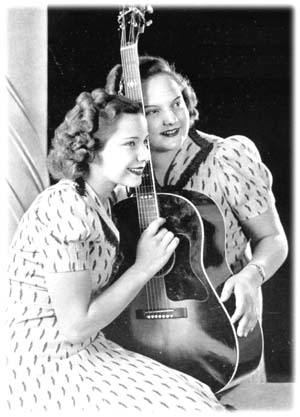 After two seasons with the Sonja Henie Review, Carolyn paid a visit
to her old home at Royalton. Minnesota. and while there was
invited to become a member of the Sunset Valley Barn Dance
produced by Dave Stone on KSTP in St. Paul. The Sunset Valley Barn Dance,
like the National Barn Dance. was a combination stage and
radio program. The weekly show was broadcast from auditoriums, theaters, and fairs
in St. Paul and various other Minnesota cities. In addition to the
Barn Dance, Carolyn was heard on KSTP's daily noontime show,
Main Street Minnesota, and on an early morning program called
Sunrise Roundup. Carolyn's fellow artists at KSTP included
eleven-year-old Little Genevive Hovde, Billy Folger, Kathy Kohls,
Al and Hank, Pop Wiggins, Cactus Slim, Hank and Thelma,
and Frank and Esther.
After two seasons with the Sonja Henie Review, Carolyn paid a visit
to her old home at Royalton. Minnesota. and while there was
invited to become a member of the Sunset Valley Barn Dance
produced by Dave Stone on KSTP in St. Paul. The Sunset Valley Barn Dance,
like the National Barn Dance. was a combination stage and
radio program. The weekly show was broadcast from auditoriums, theaters, and fairs
in St. Paul and various other Minnesota cities. In addition to the
Barn Dance, Carolyn was heard on KSTP's daily noontime show,
Main Street Minnesota, and on an early morning program called
Sunrise Roundup. Carolyn's fellow artists at KSTP included
eleven-year-old Little Genevive Hovde, Billy Folger, Kathy Kohls,
Al and Hank, Pop Wiggins, Cactus Slim, Hank and Thelma,
and Frank and Esther.
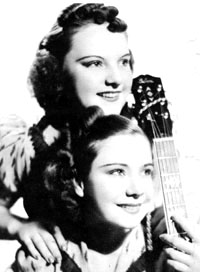 When the Polka Chips disbanded Rusty and Carolyn continued to
entertain as a duet. They were welcomed back to ABC-TV and were
soon starring in a new polka show called Polka-Go-Round that
was immensely popular on network television for the next two
years. In addition to Carolyn and Rusty, the show featured the
Polka Rounders band directed by Lou Prohut.
When the Polka Chips disbanded Rusty and Carolyn continued to
entertain as a duet. They were welcomed back to ABC-TV and were
soon starring in a new polka show called Polka-Go-Round that
was immensely popular on network television for the next two
years. In addition to Carolyn and Rusty, the show featured the
Polka Rounders band directed by Lou Prohut.