|
 |
|||||||||||
|
About The Artist
A 1973 article in the Las Virgenes Enterprise gives us a bit of background into Eddie's early career and how he met his wife, Wynn. He met his future wife when they were in high school. Eddie told the author of the article ( who appeared to also have been perhaps doing interior decorating work for Eddie at his new home then) that they would enter the amateur night contests for the prize money they offered. His wife had a roller skating act, where she used her own portable wooden floor and would entertain fans by bending over backwards to pick up a handkerchief with her teeth. But his wife chimed in and told the author that Eddie always seemed to win the contests and had her wondering if he had some kind of arrangement with the sponsors. But later, she figured if you can't beat'em, join'em and became a part of his act and eventually, it became permanent. She played accordion and did vocals with Eddie for several years until their children came along, Diane and Terri.
The author of that 1973 article tells of turning the pages of Eddie's album of flyers, hand bills, articles that showed the various venues that he played. And then came a stint at the Ambassador Hotel that seemed to have changed his musical endeavor. During that time he noticed that the folks who arrived at the hotel in Cadillacs all seemed to be wearing cowboy hats. So, he decided that it was time to quit playing the society type or pop music of the day and take up western music. That lead to the next part of his career.
As so often was the case back then, the stars or their managers thought that folks would like them more if they were truly from a western town instead of their bona fide roots. Eddie decided that being from Colgate, Oklahoma and changing his name to Eddie Cletro would sound better to the audiences. He also dropped the clarinets and trombones that were in his band and added fiddles and accordion to give him a western sound.
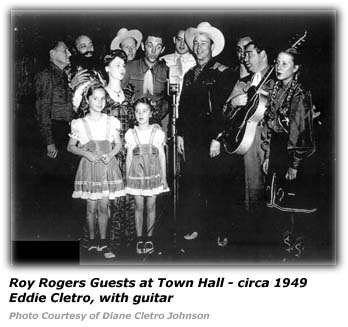
He was with Spade for about a year, then he and his band moved to begin working with Foreman Phillips in 1947 in Baldwin Park, California, and later at the Town Hall in Compton, California. Eddie told us that the Baldwin Park facility was the old El Monte Legion hall that later Cliffie Stone would host his barn dance shows from. For Eddie, it was a different type of engagement than he was used to at that time, for he had worked at such venues as the El Rancho hotel in Las Vegas and the Ambassador Hotel in Los Angeles. Around 1949 or so, Eddie prodded Foreman Phillips into trying television and also got KABC-TV interested, too. Eddie related to us this recollection of getting Foreman to make the move to television. He mentioned that when they did get the show on the air, it was pretty informal and spontaneous for the most part - no scripts. The band showed up, did their songs and bits but the fans enjoyed it all the same. All told, he was with Foreman Phillips about four and a half years. The show was called "Foreman Phillips Presents" and starred Foreman Phillips and featured Eddie Cletro and his Western Variety Band. The show aired from Stage 2 at the ABC Television Center in Hollywood. An undated newspaper photo shows Eddie along with such western stars in the Los Angeles area at the time - Carolina Cotton, Jean Howell, Foreman Phillips, Hoot Gibson, Ray Whitley and Eddie Dean - who were to appear at the 47th Annual convention of the Advertising Association of the West at the Ambassador Hotel. The group of stars were to entertain the delegates at the La Placertias Ranch that was in Newhall, California.
During these musical transition years, he found he was tapping into a different type of audience that was welcome to the western sounds he was beginning to immerse himself into. One example is from an article in the March 6-12, 1955 issue of TV-Radio Life which spotlighted the "Cowboy From Trenton". The article mentions that KTLA's Klaus Landsberg was being feted by B'nai B'rith at the Beverly Hills Hotel, a truly up scale Hollywood type setting. Eddie Cletro and his Roundup Boys were to be the evening's entertainment at this function. Picture for a moment a band of western-attired musicians at a black-tie affair with their up scale audience dressed to the hilt. Allen Rich took a bit of a humorous bent to an interview he had with Eddie back in 1954 that talked of Eddie's transition from "society" music to "western" music back then. Mr. Rich appeared to be upset that he wasn't getting to interview some of the more glamorous gals on KTLA at the time such as Dorothy Gardiner, Ina Ray Hutton and Roberta Linn. Mr. Rich asked Eddie why he switched to western music and Eddie replied succinctly, "Because I like to eat regularly."
Mr. Rich gets Eddie to relate a bit more why he turned to western music at that time, aside from the regular income. Eddie told him that "...it is more fun to play for followers of western music. Western songs ... are songs from the heart that tell a story." Eddie made quite an impression that day with Mr. Rich after having lunch with him, hearing Eddie make his case for western music, getting to see his family at his home in Sherman Oaks at the time and his two kids, Diane and Terri (7 and 4 years old, respectively at the time). He tells his readers that Mr. Cletro probably does not care if he never sees another "society band" the rest of his career. At the end of the article, he notes he saw that Eddie had over a dozen western outfits in his wardrobe closet. But only one "city" suit. In Mr. Rich's mind, Eddie was "...100 per cent cactus."
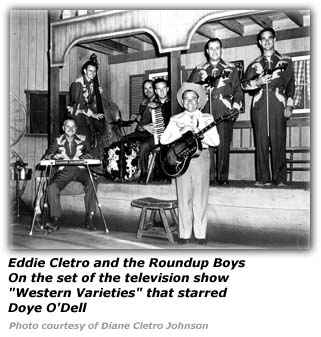
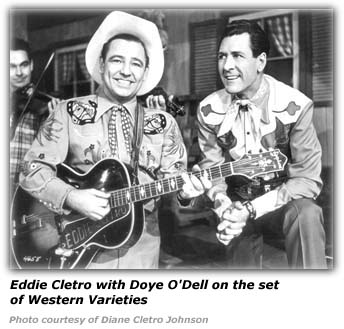
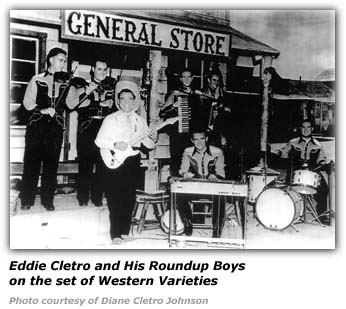
But the article notes, Eddie and the band got the folks tapping their feet to the music and won them over and perhaps maybe even found a few new fans for the western music style. Interestingly, the article notes that Eddie found that "...you don't have to come from Texas or Oklahoma to make the grade as a Western entertainer." During these times in the Los Angeles area, working on the Western Varieties show, Eddie told us that the band would be doing the show, but during the day, would be playing various engagements around the city. He told us about the times they would go to super market openings. In a sense, these were a bit like small county fairs. The markets went all out to welcome new customers. The vendors would setup tents or booths to help pass out free food samples. There would be entertainers on hand such as Eddie's band and other attractions to bring folks to the new store. Eddie continued to work in the Los Angeles area and found work in the new medium of the time, television. For about five years, he was a part of the Western Varieties show that aired over KTLA, channel 5; Doye O'Dell was the star of the show. We asked Eddie how he and his band became a part of that show. He told us that KTLA had put a call out that they were looking for a western band for a show. Eddie and his seven-piece band at the time showed up in their best western suit stage wear for the audition. He said there were a few other folks there, but mostly dressed casual and basically weren't a regular group, some just a few musicians that had gotten together for the audition. Who says a good first impression and being prepared doesn't count for something? Eddie told a newspaper reporter in a 1973 article that he had a plaque that was going into his new den. Because his musical talents saw him entertaining fans in both the 'society' and 'western' styles of music, he was given the title, "Sinatra of the Sagebrush" that stayed with him the rest of his career. Later in his career, he contacted a gentleman by the name of Rightly Perry and became a salesman for the specialty advertising business he ran - by 1973, he had been with the firm for over 15 years. The article noted that he and his wife took a trip to Hawaii for their 35th anniversary and found that people would come up to him and ask if he was Eddie Cletro - his fans still remembered him. One thing we fans enjoy reading is how the songs we listen to came to be, what gave the songwriter the inspiration. Eddie's daughter Diane told us one such incident. It came to her one night when she was about seven years old, trying to understand the 'pretend' stuff she saw in her dad's career in entertainment was all about, when her parents tucked her into bed and told her that they loved her. As a child might do, asking a question right to the point, she asked her parents, did they love her with their REAL hearts and not their MAKE BELIEVE hearts. Mom and dad may have looked at each other and soon found themselves sitting up that night writing a tune that was recorded by Noel Boggs on Columbia Records, "Make Believe Heart". He recorded for several labels including Lariat, Imperial, Decca, Columbia, Viper and Sage N Sand. Eddie Cletro and his Roundup Boys also appeared in the movie "The Trail of the Rustlers" that starred Charles Starrett, known then as the Durango Kid and Smiley Burnette and released by Columbia Pictures in 1950. Eddie and his first wife, Wynne, were married for some 54 years. She passed away in 1992 at the age of 73 from leukemia. Eddie and Wynne had two kids, Terri and Diane. Eddie remarried when he was 80 years old; his second wife's name is Susan and they now reside in Southern California. Eddie still sings and plays the guitar.
Timeline & Trivia Notes Group Members (circa mid-1950s:
Credits & Sources
|
| Printer Friendly Version |
|
Recordings (78rpm/45rpm)
| |||||||||||||||||||||||||||||||||||||||||||||||||||||||||||||||||||||||||||||||||||
Hillbilly-Music.com
Yes, Hillbilly Music. You may perhaps wonder why. You may even snicker. But trust us, soon your feet will start tappin' and before you know it, you'll be comin' back for more...Hillbilly Music.
Hillbilly-music.com ...
It's about the people, the music, the history.
|
Copyright © 2000—2023 Hillbilly-Music.com
|
||||
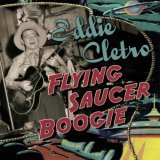
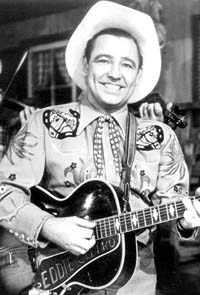
 Eddie Cletro (his real name is Eddie O'Clethero) was born in Trenton, New Jersey back in 1918. When he was nine years old,
Eddie took a liking to music and began to playing the ukulele. By the time
he was 14, he learned the guitar and was leading his first band.
Eddie Cletro (his real name is Eddie O'Clethero) was born in Trenton, New Jersey back in 1918. When he was nine years old,
Eddie took a liking to music and began to playing the ukulele. By the time
he was 14, he learned the guitar and was leading his first band.
 We tried to get Eddie to recall the first date he played for pay. He said back in
those very younger days as a teen-ager, he was just trying to find work anyplace
he could get it as a young musician would try to do. He mentioned when he started
singing when he was 12 or 14 years old, he would be doing western tunes. Later
he started doing those pop tunes of the day until he got the chance to do
western music again.
We tried to get Eddie to recall the first date he played for pay. He said back in
those very younger days as a teen-ager, he was just trying to find work anyplace
he could get it as a young musician would try to do. He mentioned when he started
singing when he was 12 or 14 years old, he would be doing western tunes. Later
he started doing those pop tunes of the day until he got the chance to do
western music again.
 The early 1940s found him working with Stuart Hamblen and the Lucky Stars over radio
station KFWB in Los Angeles, California.
He mentions in a 1973 article that Stuart's show
on KFWB ran an hour and 15 minutes each day. In the evenings, Eddie would perform at the
Tom Brenneman restaurant. Eddie noticed that the patrons didn't seem to react much
to the bands popular renditions of the day. But whenever the band slipped in a western
tune or two, their audiences would get a bit more enthusiastic. This gave
Eddie the impetus to make a switch to being a western music performer - exclusively.
The early 1940s found him working with Stuart Hamblen and the Lucky Stars over radio
station KFWB in Los Angeles, California.
He mentions in a 1973 article that Stuart's show
on KFWB ran an hour and 15 minutes each day. In the evenings, Eddie would perform at the
Tom Brenneman restaurant. Eddie noticed that the patrons didn't seem to react much
to the bands popular renditions of the day. But whenever the band slipped in a western
tune or two, their audiences would get a bit more enthusiastic. This gave
Eddie the impetus to make a switch to being a western music performer - exclusively.
 Eddie auditioned for Spade Cooley in 1946 and was hired to work in one of Spade's
three bands he had at that time. We talked with Eddie over the phone and he said
at the time, he was working six nights a week at the Palomino Nightclub in
West Hollywood. Spade would come in and sit in to listen to the bands playing
there at the time, then leave. Spade decided he had liked what he heard
at hired Eddie to play for his band at the Santa Monica Ballroom each weekend.
One New Year's eve, Eddie was the added
attraction at Spade Cooley's Santa Monica Ballroom, on the pier at Colorado and
Ocean Avenue. Imagine also if you will having to only pay an admission charge
of $2.00 that also included tax.
Eddie auditioned for Spade Cooley in 1946 and was hired to work in one of Spade's
three bands he had at that time. We talked with Eddie over the phone and he said
at the time, he was working six nights a week at the Palomino Nightclub in
West Hollywood. Spade would come in and sit in to listen to the bands playing
there at the time, then leave. Spade decided he had liked what he heard
at hired Eddie to play for his band at the Santa Monica Ballroom each weekend.
One New Year's eve, Eddie was the added
attraction at Spade Cooley's Santa Monica Ballroom, on the pier at Colorado and
Ocean Avenue. Imagine also if you will having to only pay an admission charge
of $2.00 that also included tax.
 An article in the local La Habra newspaper back in June of 1953 gives us a taste
of the promotional efforts that the local Lions Corn Festival put into its annual
affair that was to be held on Saturday, August 1 that year. The Western Varieties show was being aired over KTLA on Friday nights
at 9:00pm then and Eddie Cletro and his Roundup Boys were among the featured
stars as the Corn Festival was featuring the Western Varieties show along with Cheeta
the Chimp. A parade was held. And a new Chevrolet Bel Air Sport Coupe
was to be given away. The Lions Corn Festival also charged no admission and the
entertainment was free of charge, too.
An article in the local La Habra newspaper back in June of 1953 gives us a taste
of the promotional efforts that the local Lions Corn Festival put into its annual
affair that was to be held on Saturday, August 1 that year. The Western Varieties show was being aired over KTLA on Friday nights
at 9:00pm then and Eddie Cletro and his Roundup Boys were among the featured
stars as the Corn Festival was featuring the Western Varieties show along with Cheeta
the Chimp. A parade was held. And a new Chevrolet Bel Air Sport Coupe
was to be given away. The Lions Corn Festival also charged no admission and the
entertainment was free of charge, too.
 Mr. Rich embellishes the story a bit, positioning Foreman Phillips as the "...world's
greatest exponent and promoter of western bands, dances and radio shows". He was said to
have 'made a cactus' out of Eddie and was eating regularly ever since he worked
with Mr. Phillips.
Mr. Rich embellishes the story a bit, positioning Foreman Phillips as the "...world's
greatest exponent and promoter of western bands, dances and radio shows". He was said to
have 'made a cactus' out of Eddie and was eating regularly ever since he worked
with Mr. Phillips.
 When his daughter, Diane, was about nine years old, Eddie recorded a holiday record
with her, "Santa Claus, Jr." for Sage & Sand Records. Diane told us that it was quite an experience for a
little girl. She recalls they recorded the tune at Eddie Dean's home studio. They
worked until nearly 2:00am to finish the final recording of the tune. She remembers
later, it led to lots of personal appearances, autograph signing sessions, as well
as an appearance with her dad on the Western Varieties television show.
When his daughter, Diane, was about nine years old, Eddie recorded a holiday record
with her, "Santa Claus, Jr." for Sage & Sand Records. Diane told us that it was quite an experience for a
little girl. She recalls they recorded the tune at Eddie Dean's home studio. They
worked until nearly 2:00am to finish the final recording of the tune. She remembers
later, it led to lots of personal appearances, autograph signing sessions, as well
as an appearance with her dad on the Western Varieties television show.