|
 |
|||||||||||||||||||||
|
About The Artist In Progress... First published: August 2008
The family lived in the country on Woodbine Road in a house their Dad built with his brother-in-laws, brothers and friends. Mary Ann remembers that their mother grew vegetables in a garden at the side of the house and canned most of their food. Both parents worked very hard. Many homes in that era didn't have something we take for granted today - an indoor bathroom. She remembers when she was about seven years old when their home did have that new luxury. But she still remembers that the outhouse was behind the garage and recalls to this day the memories of many, many cold trips through the snow in the winter and that not too pleasant odor in the warmer months. Mary Ann tells us she most certainly learned a lot from her Mom, but her love of country music came from her Dad. He was born and raised in Ragland, Alabama. The very first song that she learned by heart (other than hymns they sang in church) was "Nobody's Darlin' but Mine", a tune that Jimmie Davis had a big hit with. In January of 1945, she graduated from Yost Grade School at the age of 12 and a half. She was one of just five other kids that comprised the entire class! Shortly after that, the family moved from the house on Woodbine (the house Mary Ann said she had grown to love so much and still does to this very day) to a new house in Redford with a basement and yes, a bathroom! The home was a dream come true for her Mom. Mary Ann's two older sisters married at the ages 17 and 18. That meant only her sister "Sugar" and Mary Ann were still at home. But tragedy struck on May 26th, 1946; their mother died at age 49 from poly cystic kidney disease. Mary Ann was just 13 years old. Her brother, Earl, was in the army; serving in Japan at that time. When Mary Ann was 16 and a senior in high school, she formed a hillbilly band called "Cactus Lou and her Prairie Pals." It consisted of a bass player, two guitar players and another who handled the ukulele. It was almost impossible to find anyone that played those instruments, but she had the help of her high school music teacher, Gene Fenby, she managed to find some 9th and 10th grade kids who knew how to play them. She came to feel like cupid because the boy who played the bass fiddle and one of the girls who played one of the guitars eventually got married—Robert Gawlas and Barbara Barton. The group played at all the school venues that called for entertainment like the Senior Mixers and Benefit Shows. In January of 1950, Mary Ann graduated from Redford High. It was around this time she took to honing her vocal talents by lying on her back and placing heavy books on her chest to help give her voice more strength. As we shall see, that little bit of home grown training and practice certainly paid off. On December 4th, 1951, her father died of cancer at age 54. Six months later she went out on my own and got a job as a stenographer/typist for a surgical supply company earning $35.00 a week. Shortly after that she was offered a job as a secretary/payroll clerk for a company that made steel castings that included a raise in pay to $57.00 a week. That opportunity and change of jobs came at a great time for her because she was dependent on buses and rides from other people to get her around and well, she really wanted her own car.
She got very ambitious and was eventually working five different jobs at one time and saving every penny. In addition to the secretarial job, she worked at Drake's Record Shop each Saturday Morning in downtown Detroit where she got paid a bit differently—a record an hour— Mary Ann notes, she needed to learn songs. She was a Carhop at a drive-in restaurant from 9:00pm to 2:00am three nights a week; she sold tickets at the Redford Theatre on Saturday and Sunday afternoons; and, by that time her musical talents got her hired by Casey Clark as his "Girl Singer." Casey paid her $10.00 every Saturday night. At that point in time she had decided she was not going to make it as a singer; so she tried her hand at song writing. 

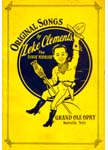
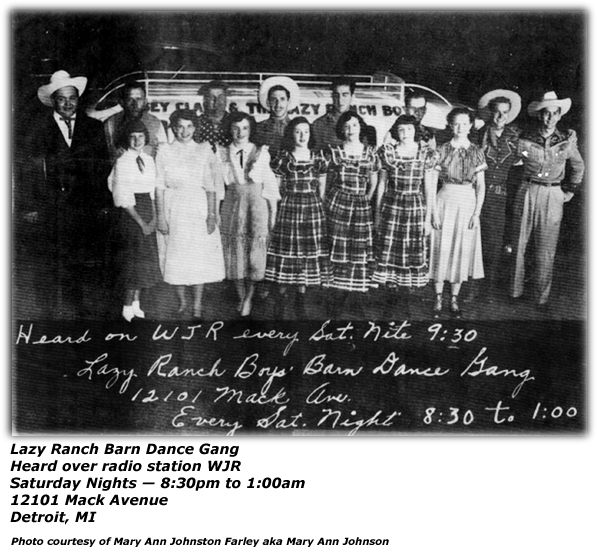
Mary Ann wrote on this flyer: "One of the biggest and best surprises I'd ever had in my life was when Casey Clark hired me as his featured girl singer!" Mary Ann and her sister Sugar would go to Casey's barn dance every Saturday night. It worked out well for both of them because Mary Ann wanted to be around music and her sister, well, wanted to meet the guys. When Mary Ann heard Little Jimmy Dickens was going to be a guest on Casey's Saturday Barn Dance Jamboree, she asked Casey if he would give him one of the songs she wrote just for Jimmy called "Keep the Change". Casey asked her to sing it for him and she did, right there on the spot. Casey gave his guitarist a nod of approval and Herb nodded back. She remembers being so excited she couldn't sleep at all that night. The next day, a Sunday, she answered a phone call and it was Casey. He called to ask her to be the female singer in his group. She was dumbfounded at the time. But, she found the sense to tell him, "Oh yeah", of course.
  Casey's Lazy Ranch Boys Barn Dance show was quite a troupe. There was a 12-year old singer by the name of Little Evelyn. Herb Williams did vocals and played guitar. Chuck Carroll was another feature. Barefoot Brownie provided the comedic angles. Charlie and Honey Miller were known as the West Virginia Sweethearts along with another act known as the Callaway Sisters. Mary Ann's best friend was Beatrice Wadaker (she later became her sister-in-law by marriage to her brother) could sing rings around ANYONE from opera to country-western. She was Mary Ann's biggest influence along with Hank Williams and she taught her how to sing harmony by singing one part into a reel-to-reel tape recorder and then singing another part along with the tape when I played it back. This seemed to help Mary Ann quite a bit; she could not read or write music. So, Mary Ann would sing into a reel-to-reel and Bea's father would convert the melody she sang into sheet music. Whenever she wrote a song, she would call her up and sing it to her because she could never get over the fact that she could actually do this. Bea would always tell her, "Nope. You wrote it. Never heard it before." However, death found its way into her life again. Bea sang mostly in church and local shows, which meant that when Bea died of breast cancer in 1997, much of the world had never had the pleasure of hearing her friend's awesome voice. After Mary Ann got married, Bea and Mary Ann formed a little group called the "Country Folks" with her two sons Mark and Bryce and Mary Ann's daughter, Leisa. They played local venues such as Scouting Events and Christmas Pageants. While she had learned to play the guitar earlier in her life, she practiced her guitar techniques every chance she could and found the time to take lessons from Gene Nelson. But she wasn't only practicing her guitar; she took to strengthening her lung power by lying under a table with her phonograph on top of it playing Hank Williams records. Using this technique, she would sing along and put a book on her chest while lying under the table and would add a book every few days until, eventually, she had to stop at 4 or 5 because she couldn't reach her guitar strings! When she was about 20 years old, Gene gave Mary Ann her first professional job singing with a group known as the "The Southerneers". She stayed with the group from October 1952 to October 1953. That first gig paid $7.00 a night.
When 1952 showed up on the calendar, she had saved $1,000, which enabled her to put a down-payment on a brand new 1952 Chevrolet. That car cost $2,000 but she thought it was worth it to not only go hungry every once in a while, but also forgo buying clothes as much because she was finally feeling a bit more independent. She could go wherever she wanted whenever she wanted. With that newfound freedom, that meant she could go to radio stations and introduce herself to the disc jockeys so they could put a face to the name when her songs would hit the airwaves. This proved to be a very smart thing to do because for when stars came to town to be guests on Casey's shows, Mary Ann would take them to meet the various country disc jockeys in the area. One she remembers in particular was Jack Erie on radio station WEXL over in Royal Oak, Michigan.
 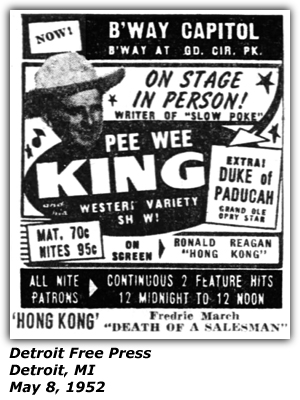 In May of 1952, she met Pee Wee King when he was playing a personal appearance at the Broadway Capitol theatre in Detroit. Neal Burris was touring with Pee Wee at the time; the Duke of Paducah was also part of Pee Wee's show. Neal himself had recently signed a recording contract and had released "There's No Reason." Neal and Bob Koefer (Pee Wee's Steel guitarist) had heard Mary Ann and her sister-in-law singing a song backstage that Mary Ann had wrote. The song was called "Honey Baby Blues". Neal liked it so much he offered Mary Ann a contract for the rights to record it himself on the Columbia record label. Pee Wee King's Ridgeway Music Co. ended up publishing the song. The recording was released in October of 1952. It quickly rose to No. 1 on the Hillbilly Hit Parade in Detroit where it remained for ten weeks. Neal's version is on Columbia 21026. It can be found on youtube.
Honey Baby Blues When the calendar pages were showing December of 1952, Casey Clark started his famous Big Barn Dance Jamboree with his "Lazy Ranch Boys." Casey insisted that Mary Ann audition for the show; afterwards, he hired her as the featured female singer. That meant she could now consider herself a professional singer. In June of 1953, Neal and Mary Ann got together and wrote another tune called "You're Stepping Out (To Be With Me)", which Neal also recorded on Columbia 21114. It can also be heard on youtube. It is the kind of country music that you do not hear today.
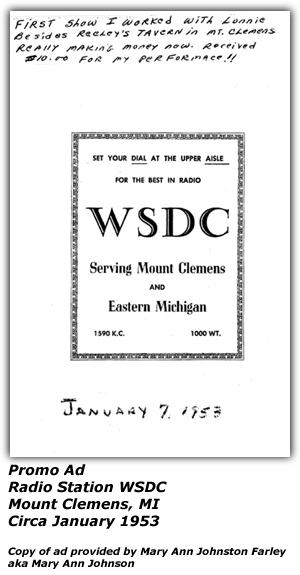
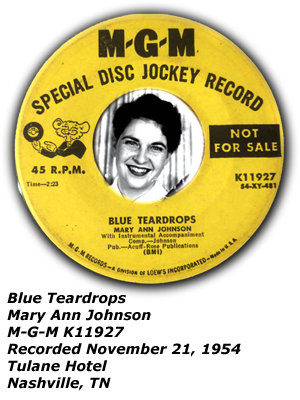
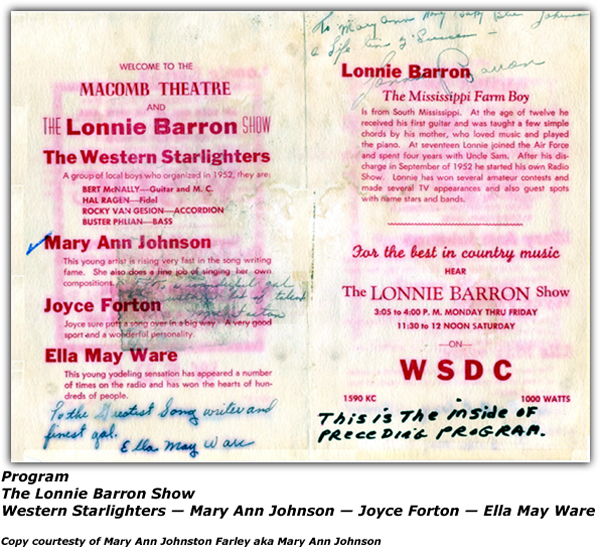
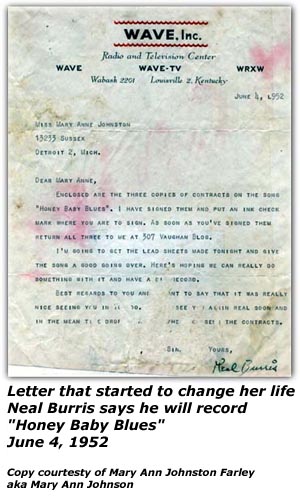 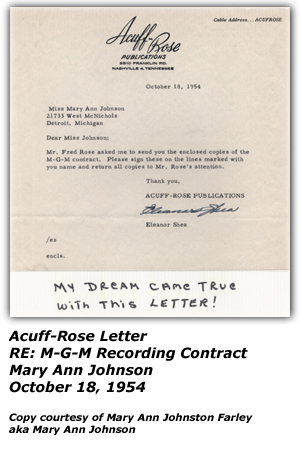 She landed her first radio job in July of 1953. It was on a Saturday night show called the Barn Dance on radio station WXYZ out of Detroit, Michigan. They also had a daily 15-minute show over WEXL in Royal Oak, Michigan. Mary Ann also worked with Lonnie Barron on radio station WSDC in Marine City, Michigan on Friday Nights and Sundays. Mary Ann and the Lazy Ranch Boys made personal appearances all over Michigan and Ohio during the week. But the musical aspect of her life wasn't her only source of income; she still kept her day job as a secretary. Casey and his troupe, including Mary Ann, moved to radio station WJR in Detroit in September of 1953; WJR was a powerhouse station, 50,000 watts. At that same time, she auditioned for Mercury Records during a vacation in Nashville. But it didn't pan out that time around for on November 3, 1953, she received a letter saying they couldn't use her. On November 15, 1953 Mary Ann did her last show for Casey Clark and headed back to WXYZ to sing on an hour show each Saturday night called the "Motor City Jamboree" which featured a different Grand Ole Opry each week. A 1954 article notes the show was broadcast on Saturday nights from 9:00pm to 10:00pm from the Madison Ballroom. Besides Mary Ann, other featured local acts were Danny Richards, Whitey Franklin, Al Allen, and Happy Moore. Those shows also included appearances by such stars as Webb Pierce, Carl Smith, Little Jimmy Dickens, George Morgan, Lester Flatt and Earl Scruggs and many others. But things took a turn for the worse in March of 1954; the show had become too expensive for the local sponsor which led to the station dropping the show. That meant Mary Ann was out of a musical job. But not for long. She joined up with the rodeo show that starred California Joe and his trick horse Pinto, Sharp Shooter and Rope Twirler Montana Frank and a Western band with whom she became a part of. The group made appearances throughout the Michigan and Ohio areas. She worked with them until July of 1954. But she was still not satisfied. She decided to go out on her own and formed a six-piece band called "Two Tall, Two Small". She sang high-tenor and also booked all of the group's shows. Mary Ann made another trip to Nashville in September 1954 where Nelson King arranged an audition for with Fred Rose of Acuff-Rose Publications. Fred listened to her and arranged to make a tape of her vocal efforts. Fred must have liked what he heard for on October 7th she received a letter from him that contained a 3-year recording contract with the MGM label. Mary Ann tells us a few more details about that contract. Fred personally cut a demo record of a couple of songs for her, "Lend Me Your Handkerchief" and "Just What I Always Wanted" and sent it to her to help prepare her for her first recording session in Nashville for MGM. She did not write those two tunes. But she fondly remembers that she recorded four sides during the annual WSM Disc Jockey Convention in Nashville in November of 1954. She remembers she had been awake almost three days straight from the excitement and anticipation of that first recording session. The musicians backing her were a page from country music history - Chet Atkins on guitar, Jerry Byrd on steel guitar, Tommy Jackson on fiddle, but she can't remember who the piano player was. She said Mr. Rose had a hard time getting the right balance in the studio for her loud voice - she proudly notes - "the books on my chest paid off!" They tried putting her in a big cardboard box, similar to the type a refrigerator might come in. Unfortunately for many young stars of that era associated with Acuff-Rose and MGM, Fred Rose passed away at the age of 57 in December of 1954. As events unfolded after his passing, the release of her recordings was delayed. She did get a glimpse at the plans Fred had for her. She was shown a mockup of a layout they had made for Billboard magazine, touting her as the "female Hank Williams". That type of compliment gave her a boost, but at the same time left her wondering what might have happened.
The opening line of the article, "Sex and glamour are strictly taboo for the gal who wants to get ahead in hillbilly music." The journalist cited Ann Jones, Mozelle Phillips as two other female singers who agreed with that statement. Further, he noted that "To be successful in country music, particularly as an artist, a woman should stick to ginghams and steer clear of fancy hair-dos and figure-revealing clothes." And further, "If you've got glamour, play it down." She had just joined the WHAS staff. She told Mr. Eisen, "I like the ballads and the sad songs best. For me, the sadder, the better. And how could I sing sad and look like..." She was telling Mr. Eisen she agreed with the other female singers perspective. Perhaps she did know what suited her best. An undated review of her recording of "Lend Me Your Handkerchief" on MGM in 1955 noted, "...sounds very good indeed in our ears as she presents...a wonderful and sad ballad that becomes a favorite on just one hearing." In fact, in 1955, she recorded the song she had given to Little Jimmy Dickens a few years back, "Keep the Change". IN April 1955, he did a guest appearance on Pee Wee King's television show at WBBM-TV in Chicago. She then did a personal appearance with Homer and Jethro at the Lyric Theater in Indianapolis, IN to promote her first M-G-M release. One magazine that tried to write reviews of the latest singles but often time fell into a tongue-in-cheek play on words mentioned her MGM recording as she "...fills the ocean with her tears, then she warns that she is no bargain-counter girl." She wrote the "A" side of that records as well, "Blue Teardrops".
 
With that contract in her possession, she quit her secretarial day job for Lincoln-Mercury on October 27th, 1954 and moved to Louisville, Kentucky. Bill King became her personal manager. He arranged an audition for her at radio station WHAS, and also with Randy Atcher as well as the TV Program Director Ralph Hansen and the radio program director, Sam Gifford. Her audition included her rendition of one of Hank Williams' songs, "You Win Again". Sometimes it's a matter of being at the right place and right time. Her stint at WHAS was one such occasion. The regular featured female singer, Rita Robbins, decided to leave WHAS within days without warning after Mary Ann had joined the staff. Mary Ann found herself in the right place at the right time.
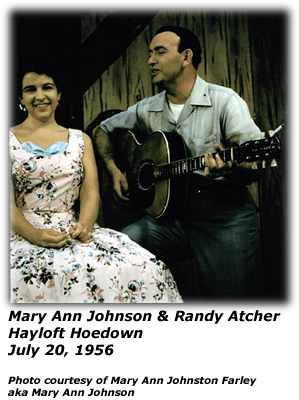
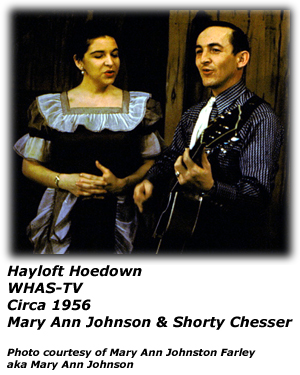
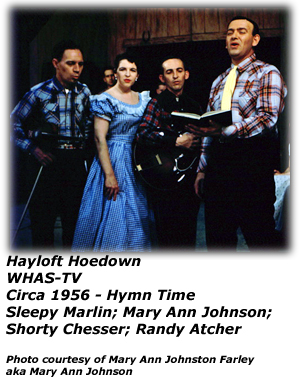
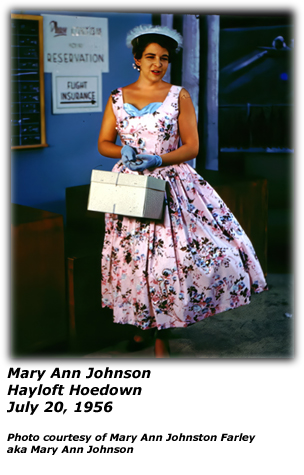
The appearances on the CBS network sparked another new aspect to her career. A young lady by the name of Dorthea Ann Ritzel from Rochester, New York started a fan club for Mary Ann. She was astounded and happy for something like that to happen. Mary Ann kept in touch with her for years after she left the music business. She tells us she was never so happy in her life back then; she felt she was actually living her dreams. All of the Randy's group, the Red River Ramblers were ten years older than she was and they became the dearest friend to her as well as father figures. She remembers that between shows, she put her secretarial skills to read and organize all of their fan mail. This enabled her to help organize their "by request" programs. All the guys seemed very happy to not have to worry about this chore that she handled so ably for them. It was during that time she met her future husband, John Farley, on the set of one of those programs. He was one of the directors of "Hayloft Hoedown". The two of them fell in love and were married in Michigan on August 4, 1956. After getting married, they moved to New York for a while until John was offered a writing job at a company in, located in believe it or not she notes, Detroit.
  She didn't want to help him decide to take the job even though she deeply missed her hometown, family and friends. In the end, he took the job and they moved to Michigan in 1957. Their marriage has been one for the ages and as of 2007, they have been married 51 years. In 1998, her health had taken a turn for the worse. She had a kidney transplant; the kidney was donated by the parents of an 18 month old baby girl named Becca. Mary Ann was 66 years old at the time. When Mary Ann was younger, she notes she constantly had music running through her mind. If she were driving and new lyrics or a new melody would pop into her conscience, she would just simply pull over to the side of the road and write them down. But when she got married, the lyrics and melodies stopped. She felt it was almost as if God had only loaned her the talent in order to meet her husband and raise their four children—all loved and all made a positive contribution to this world. She did manage to write a couple of musical nursery rhymes for her family from time to time and also managed to write a bit of poetry and a few children's stories.
  John and Mary Ann were blessed with four amazing children as she describes them. Leisa Jayne who was born in 1957 and married Charles Passarelli in August of 1979. They have raised three grandchildren, Travis, Kaleigh and Tessa. Leisa and Chuck both teach at the Seaholm High School in Birmingham, Michigan. Both are in the prestigious "Who's Who in Teaching". Their oldest son Kenneth was born in 1959. He and his wife (they were married four years) had a daughter, Claire. Ken owns a successful lighting design company in Haverston, New York called Illumination Production Services. Their second oldest son, John Farley, Jr. works for Michigan Chandelier as an Information Technologist. Their youngest son, Chris is a feature film director in Los Angeles. He has his own production company called "Lost City Entertainment" with which he recently finished a film that he wrote, directed and starred called "Atom Nine Adventures" which you may read more about at www.atomnine.com (Note: The website appears to be inactive. An Adobe flash image is on the home page, but browsers no longer support flash.) For Mary Ann, she feels that there are so many lives that come and go; so many stories. And this one happens to be hers. Yes, she can say that she was blessed to have lived her dream as a singer and songwriter. But as she would discover after living that dream, nothing is as amazing, satisfying or fulfilling as being a mother and grammy. On August 31, 2015, her husband, John Redmond Farley, passed away at the age of 88. John and Mary Anne had been married 59 years. Lt. Colonel Farley was buried in the Arlington National Cemetery; he served his country in the U. S. Air Force in World War II and Korea. Billboard magazine reported their engagement in the January 28, 1956 issue. He was a pop disc jockey at WHAS at the time; she was working with Randy Atcher and his Red River Ramblers. Their engagement announcement was in the January 22, 1956 Louisville Newspaper, The Courier-Journal. Mary Anne Johnston Farley passed away at the age of 88 on August 13, 2020 in Farmington Hills, MI.
Credits & Sources
|
| Printer Friendly Version |
|
Recordings (78rpm/45rpm)
| |||||||||||||||||||||||||
Hillbilly-Music.com
Yes, Hillbilly Music. You may perhaps wonder why. You may even snicker. But trust us, soon your feet will start tappin' and before you know it, you'll be comin' back for more...Hillbilly Music.
Hillbilly-music.com ...
It's about the people, the music, the history.
|
Copyright © 2000—2023 Hillbilly-Music.com
|
||||
 She was born Mary Anne Johnston in Redford, Michigan in 1932 though a 1955 article
mentions she was born in Ragland, Alabama. Country
music fans would come to know her as Mary Ann Johnson. She was the youngest of five children. Her siblings were Justine
(born in 1924), Eleanor "Babe" (born in 1925), Earl ll "Boy" (born in 1926) and Ramona "Sugar" (born in 1929).
She was born Mary Anne Johnston in Redford, Michigan in 1932 though a 1955 article
mentions she was born in Ragland, Alabama. Country
music fans would come to know her as Mary Ann Johnson. She was the youngest of five children. Her siblings were Justine
(born in 1924), Eleanor "Babe" (born in 1925), Earl ll "Boy" (born in 1926) and Ramona "Sugar" (born in 1929).
 A 1954 article in the Louisville Times by Jack Eisen gives us a bit of insight to what
it was like to be a female performer country music singer back in those days. Reading it, one
is struck by the contrast to what was deemed acceptable back then compared to today's generation.
A 1954 article in the Louisville Times by Jack Eisen gives us a bit of insight to what
it was like to be a female performer country music singer back in those days. Reading it, one
is struck by the contrast to what was deemed acceptable back then compared to today's generation.

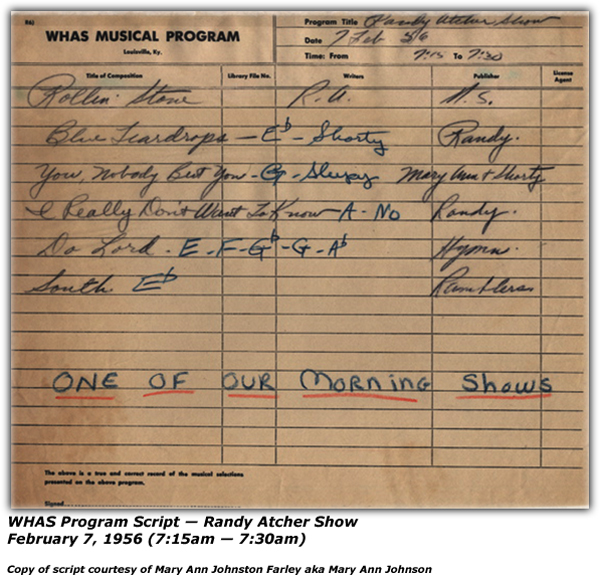
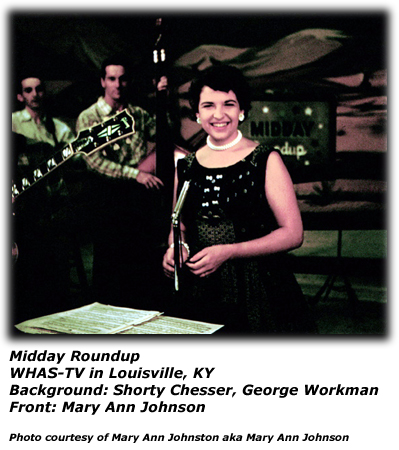
 After they hired her, she started doing the 6:00am and 7:30am radio shows, Monday through
Friday. She also appeared on the "Midday Round-Up" with Tiny Thomale and the Red River Ramblers,
which included Shorty Chesser, Bernie Smith, George Workman and Sleepy Marlin.
She was also booked on the "Hayloft Hoedown" television show on Friday nights. She was also
on the "Old Kentucky Barndance" every Saturday night and every third week, that show
was aired over the CBS network as "Saturday Night Barndance".
After they hired her, she started doing the 6:00am and 7:30am radio shows, Monday through
Friday. She also appeared on the "Midday Round-Up" with Tiny Thomale and the Red River Ramblers,
which included Shorty Chesser, Bernie Smith, George Workman and Sleepy Marlin.
She was also booked on the "Hayloft Hoedown" television show on Friday nights. She was also
on the "Old Kentucky Barndance" every Saturday night and every third week, that show
was aired over the CBS network as "Saturday Night Barndance".