|
 |
|||||||||||||||||||||||||||
|
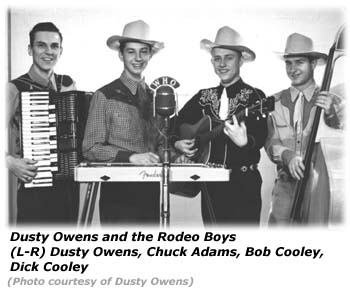
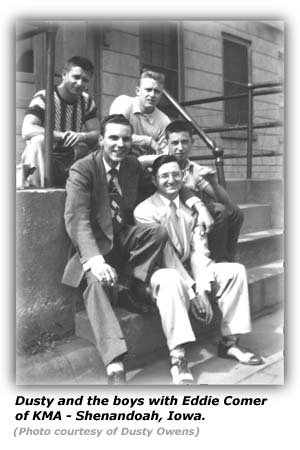
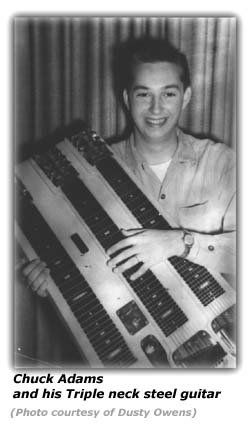
That Buick was really loaded, if you can imagine it. The trunk was packed with my accordion, Chuck's steel guitar, Bob's guitar and some suitcases. In the back seat behind the driver a couple more suitcases and clothes hanging on a hook. Dick's bass was tied on top with a tarpaulin in case it rained. We sat two in the front seat and two in the back. That Buick looked like a speedboat with its nose up and backside down, going down the road! We slept in the car all night while one person drove, in order to save money. Our first stop was Davenport, Iowa, to talk to the folks at WOC. This radio station along with WHO in Des Moines was owned by B. J. Palmer, who started the School of Chiropractic in Davenport. Months later I would have the opportunity to meet this gentleman. WOC had live talent, but no openings at the time. They suggested that I get in touch with their sister station, WHO. But first, I called WMT in Cedar Rapids, because I remembered that Tom Owens (no relation of course) had a band at that station. And, they had other musicians there also. They told me that they were filled up. So, we headed for Des Moines. Being the leader of the band it was up to me to talk to the Program Director, Jack Kerrigan, while the others waited in the car. Mr. Kerrigan agreed to give us an audition since they were losing a country family act. I was ecstatic. I rousted up the boys and we began unpacking the instruments. I remember that our pant legs looked like stove pipes from sleeping in them over two nights. I don't think we smelled too bad!
Mr. Kerrigan introduced me to Cliff and Helen Carl. They were in charge of the Barn Dance and for booking the various acts on personal appearances. They also performed on the Saturday night show.
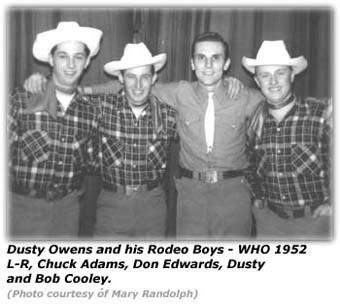
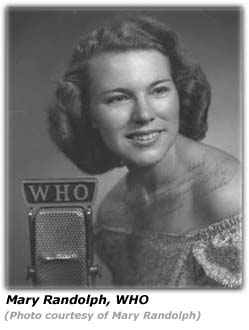
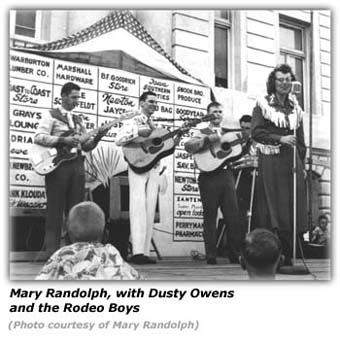
A few months after we started, in 1952, WHO hired Mary Randolph and gave her a show of her own. Also, she was added to our show to give it a feminine touch. Mary came to Des Moines from St. James, Missouri and was a terrific singer, very smooth and true. Prior to coming to WHO, Mary had work at KWTO in Springfield, Missouri. She was a singer on that station with Porter Wagoner, Speedy Haworth, and none other than Chet Atkins. This was before Wagoner and Atkins ended up in Nashville. At one time, Speedy was a member of the Buckaroos Band and played guitar on WHO. Porter and Speedy came to Des Moines in 1952 and did a guest appearance on the Iowa Barn Dance Frolic. Anyway, Mary and I began to include duets on our shows like, "I'll Never Be Free, " "Rollin' In My Sweet Baby's Arms," and "Columbus Stockade Blues." She was a regular hit on the Iowa Barn Dance Frolic as well as on personal appearances when she was on the show with us.
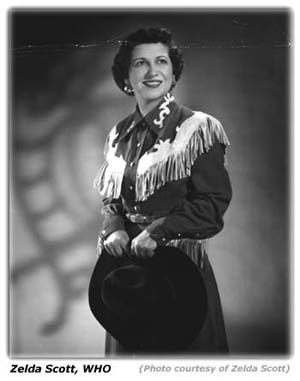
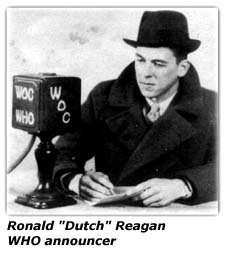
Another great female singer was Zelda Scott. Zelda's singing career began at WHO in the Forties and lasted 19 years. The first eight years, she spent singing on the air with Jerry Smith, the Yodeling Cowboy. Zelda told me that she remembers when Ronald Reagan visited the radio station in 1943 as a movie star. In the Thirties, Dutch, as his friends called him, was a very popular sports announcer at WHO before going to Hollywood, California to begin his acting career.
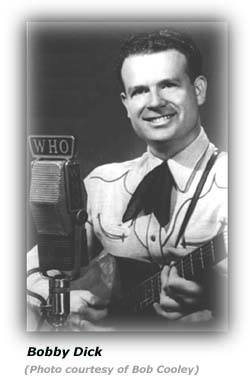
Zelda also sang duets with her sister, Fay Geisler, and when Mary joined WHO, she was added to form the Blue Ridge Mountain Gals. They sang beautifully together and were one of the favorites of the Frolic in the early Fifties. Bobby Dick became a regular at WHO in 1952, coming north from Topeka, Kansas, where he had starred on the Kansas Roundup show on WIBW. He was a fine singer and had a daily show on the station besides appearing on the Frolic every Saturday night. Also, he sang duets with Zelda Scott. I liked Bobby a lot. He was a mild-tempered mid-westerner, who never got rattled over anything. Just a regular guy!
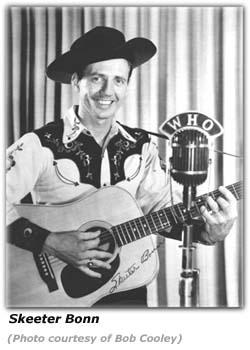
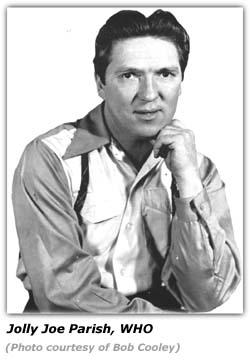
If my memory serves me correctly, Bobby Dick took the place of Skeeter Bonn after Skeeter went to WLS in Chicago. Skeeter was at WHO when we started and was a great singer and yodeler, and, of course, a regular on the Frolic. I ran into Skeeter a few years later at WWVA in Wheeling, West Virginia, where I also recorded him on Admiral Records. One of the best comedians in the business was Jolly Joe Parish and he worked at WHO the same time we did. I'm not sure if Joe was out of the hills of Kentucky or Tennessee, but he was a funny man. He was a good musician also, and played the mandolin and sang a good country song. Joe had written some songs and wanted me to collaborate on a couple. Together, we wrote "The Life You Want To Live," and "Forget My Broken Heart." A few years later, Acuff-Rose Publishing Company published them, and I recorded them for Columbia Records. The first one hit the charts, and the second one mustered a lot of plays from the jocks. They brought in a few shekels, and I was glad especially for Joe. He had six kids!
The radio station supported three bands, The Buckaroos, Cowboy Em and his Docey- Doe Boys, and ours, The Rodeo Boys.
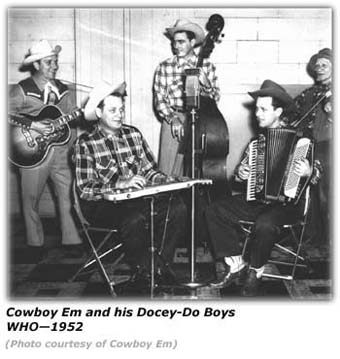
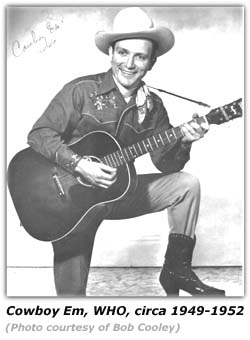
Originally, the bandleader was Kenny Houchins and the band was called The Borderland Buckaroos. After Kenny left, Cece Hunsinger became the head honcho and Slim Hayes was given a more prominent place in the limelight as a singer. In those days, Speedy Haworth was the lead guitarist with the Buckaroos. Cowboy Em and the Docey-Doe Boys consisted of Norval Ulrich, lead guitar, Roy Shaw, bass, Joe Zanotti, accordion, and Lew Martin, fiddle, who became the comedian, Uncle Twid. They were with WHO for four years. Cowboy Em's given name is Embert Mishler, and he did most of the solo work which included yodeling. They featured homey ballads, fast breakdowns and old hymns, plus square dance callin' by Cowboy Em. Norval and Roy played the part of Clem and Little Buford, the Country Cousins, and would bring the house down with their pickin' and singin' of hill-billy comedy songs. I understand that Em went on to really establish himself in the country music business in Denver, Colorado. In fact, he was inducted into the Colorado Country Music Hall Of Fame. Congratulations Em!
I asked Ray how he stayed on top of the latest songs and this was his answer: "We didn't have electricity yet, but our Uncle Clifford who lived up the farm road from us did. He had the first phonograph around. It was a Motorola and only played 78 rpms. Mom and Dad would buy a new Hank Snow record and up to Uncle Cliff's we would go. Since this was before I learned shorthand, Uncle Cliff would play a line or two and we would write the words down. That's how we kept up with the latest!"
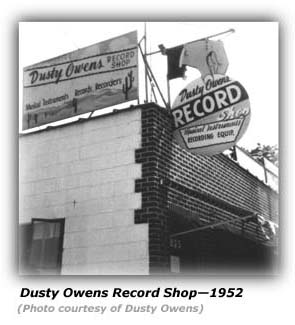
Thinking we were going to be living in Des Moines for the rest of our lives, Betty and I invested in a Record shop in 1952. We enjoyed being close to the record scene, and it helped me to stay up on the latest releases. Also, it gave Betty something to do. She ran the shop when I wasn't there, and that was most of the time. It gave me opportunity to add valuable records (78's at that time; 45s came out in 1954) to our collection, like a complete set of Hank Williams and Luke the Drifter on MGM, and all of Elvis Presley's Sun records, just to mention a few. Many of those Hank Williams songs came in handy later in my career.
Right after we bought the record shop, Uncle Sam fired a salvo our way. The Korean conflict was going hot and heavy, and I guess he decided to call on Dusty Owens for some help. Anyway, I was called up to report for induction into the Army. I was the right age and yet we were not expecting it to happen. All kinds of things went through our minds, mostly about my musical career. To say that I was glad to go would be stating an untruth, since my career seemed to be going in the right direction. Yet, I knew that many of our young boys and girls had made great sacrifices, some with their very lives, and I should be willing to give as well. We really had mixed emotions about the whole thing. To put it in a word or two, we anguished over the matter. I reported to the recruitment office, along with a hundred others, and we began with the typical physical. They questioned me about my previous medical history and I admitted that I had a severe case of stomach ulcers while in high school. They noted that, and I continued with the examination, filling out some papers along the way. I thought of applying for Special Services, which would have enabled me to continue with my singing and playing career, howbeit, I would be entertaining the troops. But that bridge was never to be crossed. At the end of the day, one of the soldier boys took me aside and informed me that based on my previous problem with ulcers, Uncle Sam didn't want anything to do with me. I think he said, "When we call up the women and children, we'll probably call you!" So, I was classified, 4F! Mixed emotions!
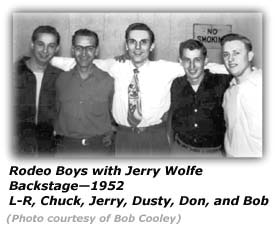
I'll never forget the first time I met Smokey Smith. He was a very talented man, who had a personality that won you over immediately. I learned to love ole Smokey like a brother. In a sense, he was our rival on another station, KRNT, where he was a Disc Jockey. But Smokey was more than just a D.J., he was one of the greatest promoters I have ever known. He always had a cigar in his hand or in his mouth, just like you'd imagine a big promoter would have. I was impressed. Every so often, he would bring a big package show in, usually from Nashville, and attract thousands of people to the Shrine Auditorium in Des Moines. He would always let me in back stage to meet the performers. Thanks to him, I met just about everybody that was well known and some that was just getting started. You have to understand, I was just 22 or 23 years old aspiring to be a Super Star myself someday, so this was really a treat for me. I kind of got the idea that Smokey was looking out for me. In addition to promoting these big shows and playing their records everyday, Smokey Smith played guitar and sang pretty darn good. In fact, many times when I wasn't on the road, I joined him at a place called the Silver Saddle in Des Moines, where we entertained the folks. Smokey was a real friend. Along in the spring of 1952, I hired Jerry Wolfe, a violin/fiddle player. A violinist is one who has studied music and can read it. The violin never rests on his wrist. A fiddle player usually does not read music, but plays by "ear." He plays with the violin resting on his wrist (usually). Jerry could play both classical and western swing music. He had played with Spade Cooley in California and knew all those great arrangements to songs like, "Devil's Dream," and "Spadella." He taught them to us and we began playing them like a miniature Spade Cooley western swing band. It was really neat!
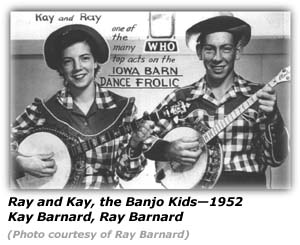
Our daily show was gaining in popularity and fan mail came in faster than ever. It was fun reading the mail. Most of the time they just simply said they were regular listeners and enjoyed the program. Sometimes, they complimented us on a certain song we did, and others requested their favorite song. Occasionally, I would get a letter that said they named their son or daughter, Dusty, after me. Sometimes, it was a dog, goat, horse, or even a duck! No matter, I always felt honored. Along with the show's popularity, came more personal appearances. We played shows and/or dances all over Iowa and into Northern Missouri as well. We even made one appearance in Omaha, Nebraska. We did the Iowa Barn Dance Frolic with the entire cast in Ottumwa on November 1, l952, which was a rare thing to do. Some of the other towns in Iowa we showed in were Centerville, Thompson, Storm Lake, Fort Dodge, Oskaloosa, Fort Madison, Burlington, Fairfield, and Boone. We did a big show on the fourth of July in Humboldt at the County Fairgrounds, along with Ray and Kay, Cliff and Helen, and the Songfellows. One of our appearances made history in Des Moines. The Riviera Ballroom at Riverview Park in Des Moines for years always had big-name bands appear for dancing: Bands like the Dorseys, Glenn Miller, Guy Lombardo, Lawrence Welk, etc. On Wednesday, June 11, 1952, Dusty Owens and the Rodeo Boys were booked to do the Riviera's very first "western dance." Here is the way it was written up in the Des Moines Sunday Register:
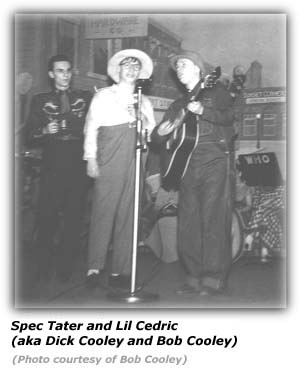
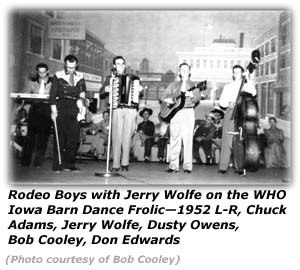
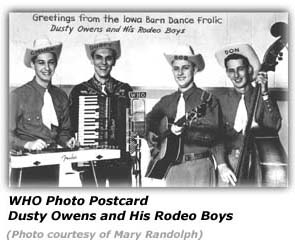
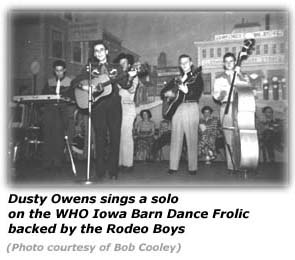
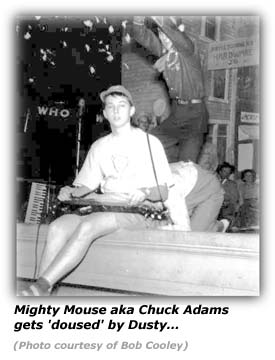
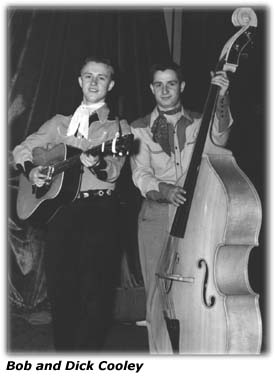
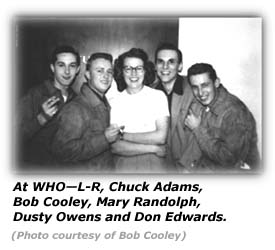
"Docey-does and the toe-tapping rhythm of a cowboy band will set the pace Wednesday night for the first "western dance" in the Riviera ballroom at Riverview. Dusty Owens and his Rodeo Boys, heard daily over Station WHO, will play for square dancing and round dancing in western style from 8:30 to midnight. Hy Rosenberg will be the caller for the square dances. Besides Owens, who sings and plays accordion, the five-man band includes regular guitar, steel guitar, fiddle and bass. We enjoyed ourselves tremendously while at WHO in Des Moines. The station had a celebrity fast-pitch softball team, made up of staff writers, announcers, musicians, and anybody from the station that thought they could play. We were called "The WHO Non-Stars," and we even had regular softball uniforms with that name blazoned across the chest. We were booked, just like our shows were, to play all-star teams from many of the towns within a hundred miles of Des Moines. Chambers of Commerce, Junior Chambers, Elks, Lions, etc. sponsored the event, and there were big crowds waiting to see their favorite radio stars. We would come into their town and play their team and sometimes just act a fool. It was all in fun and created a great relationship between the people and the radio station. There was a cute, small diner right around the corner from the radio station. It was called, Fort Junior, and was owned by a man named, George. George became a friend with all the regulars from the station who ate there. He served up fantastic food, anything from hamburgers to full meals. We often ate there. I remember he had a sign on his establishment that read, "We can seat and serve 888 people, 8 at a time." Isn't it strange what you remember after 50 years! Bob Williams played on the softball team and reminded me of the time we only could find nine players to go out to play some town (we needed 10 players to make a team). George volunteered to play and we took him even though he didn't work at the station. We put George in right field and the game began. Somewhere into the game the other team got the bases loaded and their slugger hit a tremendous blow, very high and very far, into right field. We needed George to catch this for the third out. Well, we looked up and saw the ball, it looked like a pea, still going out beyond the trees, and we looked down to find George and he was running full tilt toward us in the infield because he thought it was a pop-up! Needless to say, George and the ball never made contact, and we went back home having lost another game! George went back to his cooking! Oh, well, that's why we were called "The Non-Stars." We all loved our time spent at WHO, doing our shows on the air every day, performing every Saturday night on the Iowa Barn Dance Frolic, and traveling around the state and playing shows and dances for the great country and western friends we made. Here are more pictures taken in 1952 and the first part of 1953:
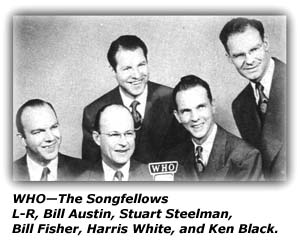
"Dusty Owens & His Rodeo Boys" program 7:45-8:00 a.m., Tuesday, Thursday, and Saturday, is cancelled July 21 and thereafter, with last live program Saturday, July 4, and last recorded program Saturday, July 18. These notices came out of the blue like lightening with absolutely no previous warning, not even a hint or rumor. We were all dumbfounded. Later, we found out that the board had decided to go into Television and needed to cut the budget in Radio. So they cut everyone but the Buckaroos and the Songfellows, and we became the victims of progress(?) Later in life, I learned about a principle that I guess I've always believed and lived by: "In every adversity lies the seed of an equivalent or greater benefit." This "firing" was the best thing that happened to Betty and me up until then, because something much, much greater was down the road for us, but in another city. We just didn't know it, nor could we see it, right then. All we could do for the next few days was to hurt real badly! Before we left Des Moines, my Fan Club President, Louise Smith handed me a poem with tears in her eyes that she had written. She didn't give it a title, but I will call it:
True Friends After the shock of feeling betrayed wore off, we all started planning what to do. Don Edwards lived in Des Moines, so he would just stay and find something else to do. Bob Cooley and Chuck Adams returned to their former homes in Flint, Michigan and played various nightspots.
“Hey, man! Listen, I’ve got a friend in my office by the name of Dusty Owens. He just got let go over at WHO and he’s looking for a place to land. He’s a young, good looking kid, and shows a lot of promise. You got an opening for such a fellow?” After about a half a dozen calls around the country, it boiled down to two that sounded promising. Horace Logan was in charge of the talent at KWKH and the Louisiana Hayride, and he was interested but tentative. The other was Gene Johnson in charge of the talent at WWVA and the World’s Original Jamboree. Gene seemed more interested and encouraged Smokey to “send the young hillbilly over to see me.” It was almost a flip of the coin that decided it, but it turned out that a chain of events helped Betty and I to make our decision. I will always be grateful to Smokey for believing in me and helping me to follow my dream. Betty and I knew that our future was out there somewhere, so we made our plans to go “on the road again.” Stay Tuned, for Dusty has told us there's more to come - the WWVA years.
Related Web Links
Sound Sample—(YouTube Video Format)
Appearance History This Month
Get The Music
|
|||||||||||||||||||||||||||||||||||||||||||||||||
| Printer Friendly Version |
|
Recordings (78rpm/45rpm)
| ||||||||||||||||||||||||||||||||||||||||||||||||||||||||||||||||||||||||||||||||||||||||||||||||||||||||||||
Hillbilly-Music.com
Yes, Hillbilly Music. You may perhaps wonder why. You may even snicker. But trust us, soon your feet will start tappin' and before you know it, you'll be comin' back for more...Hillbilly Music.
Hillbilly-music.com ...
It's about the people, the music, the history.
|
Copyright © 2000—2023 Hillbilly-Music.com
|
||||
 Mr. Kerrigan wanted us to simulate a radio show, which we did. After
the show he asked me into his office and we talked. I could tell
he was very pleased. He hired us to begin a week later. We were
to do morning a show three days a week, and an afternoon show
Monday through Friday, and the Iowa Barn Dance Frolic every
Saturday night. That show was held in the large studio at the
station to a limited audience, during the winter months. Through
the summer it was held at the Hoyt Sherman Theatre.
Mr. Kerrigan wanted us to simulate a radio show, which we did. After
the show he asked me into his office and we talked. I could tell
he was very pleased. He hired us to begin a week later. We were
to do morning a show three days a week, and an afternoon show
Monday through Friday, and the Iowa Barn Dance Frolic every
Saturday night. That show was held in the large studio at the
station to a limited audience, during the winter months. Through
the summer it was held at the Hoyt Sherman Theatre.
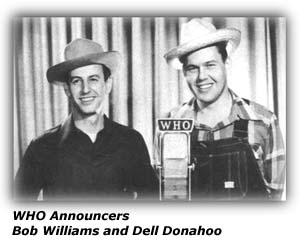 WHO was a 50,000-watt station that blanketed Iowa, Minnesota,
and a greater part of South Dakota, Nebraska, Kansas, Missouri,
Kentucky and Illinois. Saturday nights on the Iowa Barn Dance Frolic,
we reached out to another 20 states or so. I know I got fan mail
from over 30 states. We enjoyed working at the station. They had
dressing rooms in the basement fixed up very nicely for the ladies
and gents (separate rooms of course) and we had a large practice room
that included a ping-pong table. We had many a tournament
on that table. Even the announcers played when they were not
on the air. I remember two of my favorite announcers were pretty good,
Bob Williams and Dell Donahoo. Bob and Dell were the masters of
ceremony on the Frolic every Saturday night.
WHO was a 50,000-watt station that blanketed Iowa, Minnesota,
and a greater part of South Dakota, Nebraska, Kansas, Missouri,
Kentucky and Illinois. Saturday nights on the Iowa Barn Dance Frolic,
we reached out to another 20 states or so. I know I got fan mail
from over 30 states. We enjoyed working at the station. They had
dressing rooms in the basement fixed up very nicely for the ladies
and gents (separate rooms of course) and we had a large practice room
that included a ping-pong table. We had many a tournament
on that table. Even the announcers played when they were not
on the air. I remember two of my favorite announcers were pretty good,
Bob Williams and Dell Donahoo. Bob and Dell were the masters of
ceremony on the Frolic every Saturday night.

 The leader of the Buckaroos was Cece Hunsinger, who played
accordion, Slim Hayes, played fiddle and sang solos, Red Scobee,
played the five-string banjo and bass, and Jack Lester, was their
lead guitar man, Roger Kent played trumpet and Si Reeves played clarinet. This band was on the Barn Dance for more than 10 years, and had a large repertoire of western, popular and folk tunes. Each a soloist in his own right, Reeves, Scobee and Hayes formed the Buckaroo Vocal Trio.
The leader of the Buckaroos was Cece Hunsinger, who played
accordion, Slim Hayes, played fiddle and sang solos, Red Scobee,
played the five-string banjo and bass, and Jack Lester, was their
lead guitar man, Roger Kent played trumpet and Si Reeves played clarinet. This band was on the Barn Dance for more than 10 years, and had a large repertoire of western, popular and folk tunes. Each a soloist in his own right, Reeves, Scobee and Hayes formed the Buckaroo Vocal Trio.


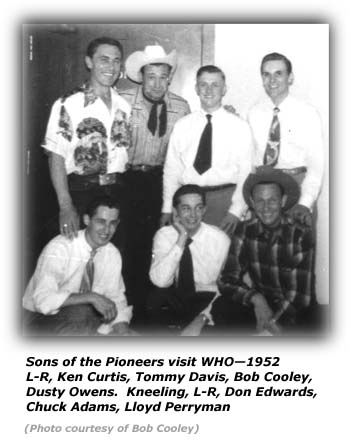 Occasionally, the station would sell time on some major function
that would bring entertainers in of celebrity status. Such was
the case in late August 1952, at the Iowa State Fair, when the
Sons of the Pioneers were booked to do an appearance at
the Fair. Three of the six members, Lloyd Perryman, Ken Curtis
and Tommy Davis came to WHO to be on our daily show to advertise
the State Fair and their part in it. What a treat that was for us.
First, we got to hear them rehearse a couple of numbers in our
rehearsal room, and then I had the privilege to introduce them on
our show. When they cut loose on "Cool Water," I thought, that
must be how heaven is with angels singing. What volume, yet with
such close harmony, was this beautiful rendition of blended human
voices. You've heard the Sons of the Pioneers; you know
what I'm talking about. Ken Curtis was the man who created and
played the character, Festus, in "Gunsmoke" several years later.
Occasionally, the station would sell time on some major function
that would bring entertainers in of celebrity status. Such was
the case in late August 1952, at the Iowa State Fair, when the
Sons of the Pioneers were booked to do an appearance at
the Fair. Three of the six members, Lloyd Perryman, Ken Curtis
and Tommy Davis came to WHO to be on our daily show to advertise
the State Fair and their part in it. What a treat that was for us.
First, we got to hear them rehearse a couple of numbers in our
rehearsal room, and then I had the privilege to introduce them on
our show. When they cut loose on "Cool Water," I thought, that
must be how heaven is with angels singing. What volume, yet with
such close harmony, was this beautiful rendition of blended human
voices. You've heard the Sons of the Pioneers; you know
what I'm talking about. Ken Curtis was the man who created and
played the character, Festus, in "Gunsmoke" several years later.

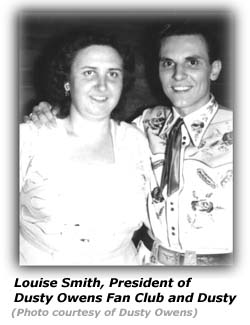 In 1952, I met Louise Smith. She and her sister lived in Des Moines
and became dedicated fans of the Rodeo Boys and mine. They attended
the Barn Dance Frolic every Saturday night and sometimes came down to
the radio station to watch us broadcast. Finally, Louise asked to start
a Fan Club for me, and of course I consented. Louise did an outstanding
job promoting me across the country and soliciting members. She would
see to it that articles and pictures would appear in other fan club
journals, and that my songs were played by Disc Jockeys on radio
stations all over the country. Computers were not available then, and
all communications were by regular mail and by phone. It was a
time-consuming job, but she loved doing it. She became like a loving
sister to me and I grew to love her too. When we lived in
Wheeling, West Virginia, Louise came out to see Betty and me,
and while with us she help put together all the pictures, articles and
such, into two scrapbooks. It was tedious work, because all the stuff had
been thrown together in a drawer all those years.
In 1952, I met Louise Smith. She and her sister lived in Des Moines
and became dedicated fans of the Rodeo Boys and mine. They attended
the Barn Dance Frolic every Saturday night and sometimes came down to
the radio station to watch us broadcast. Finally, Louise asked to start
a Fan Club for me, and of course I consented. Louise did an outstanding
job promoting me across the country and soliciting members. She would
see to it that articles and pictures would appear in other fan club
journals, and that my songs were played by Disc Jockeys on radio
stations all over the country. Computers were not available then, and
all communications were by regular mail and by phone. It was a
time-consuming job, but she loved doing it. She became like a loving
sister to me and I grew to love her too. When we lived in
Wheeling, West Virginia, Louise came out to see Betty and me,
and while with us she help put together all the pictures, articles and
such, into two scrapbooks. It was tedious work, because all the stuff had
been thrown together in a drawer all those years.
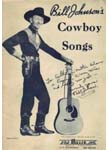
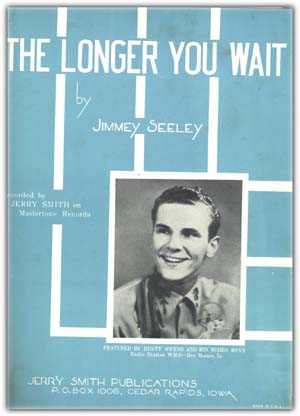 Sometime in 1952, I was asked to learn a song written by
Jimmy Seeley, "The Longer You Wait." It was a pretty song and had
been recorded by Jerry Smith on Mastertone Records. I sang it often
on our radio show and not too long after, the sheet music came out
with my picture on the cover. That was exciting!
Sometime in 1952, I was asked to learn a song written by
Jimmy Seeley, "The Longer You Wait." It was a pretty song and had
been recorded by Jerry Smith on Mastertone Records. I sang it often
on our radio show and not too long after, the sheet music came out
with my picture on the cover. That was exciting!


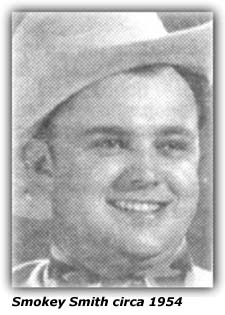 Betty and I were devastated. We didn’t want to return to Flint,
that would not further my career. So, we turned to a friend for help,
Smokey Smith. I knew Smokey had a lot of connections and could
possibly help me relocate. I can still see him, sitting behind his desk
in his office at the station, leaning back, puffing on the cigar
and staring at the ceiling, in deep thought. Then, he would pick up
the phone and dial a number.
Betty and I were devastated. We didn’t want to return to Flint,
that would not further my career. So, we turned to a friend for help,
Smokey Smith. I knew Smokey had a lot of connections and could
possibly help me relocate. I can still see him, sitting behind his desk
in his office at the station, leaning back, puffing on the cigar
and staring at the ceiling, in deep thought. Then, he would pick up
the phone and dial a number.