|
 |
|||||||||||||||||||||||||||
|
About The Artist
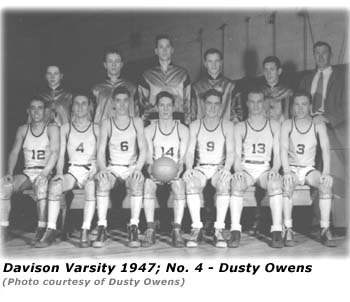
It seems that music has always been a major part of my life. My father played the plectrum banjo and the bass in a small orchestra during the thirties. Jimmy, as his friends called him, took lessons from Carl Underhill, who had studied the banjo under Eddie Peabody, the best in the business. My mother, Ann loved music too. She and dad were fantastic dancers and I have beautiful memories of watching them glide along in perfect rhythm. Jim and Ann Kucharski gave birth to three children: Robert James in 1930, Patricia Ann in 1935, and Richard Eugene in 1940. We were born in Flint, Michigan. I proudly told my friends that "I was born in the U.S.A." (Up-Stairs in an Attic) second floor over a grocery store. We soon moved to a house on Edmund Street in the north end of Flint. Dad was anxious for his son to learn music and started me on the violin at age six! My attention span was about 15 minutes and after that I didn't want to practice the violin. My instructor persuaded Dad to "stop wasting his money," and my first musical career lasted about three weeks. I was relieved. When I was seven, we moved to a small farm east of Flint on Belsay Road and I attended Howe school, a two-room wooden building located at Bristol and Howe roads. I walked a mile and a quarter to school, one way. I enjoyed entertaining the kids around me, which sometimes got me in trouble with the teacher. She didn't always appreciate my humor. A hard wrap on the knuckles with a ruler helped remind me to keep the funny stuff in check. Dad was convinced there was some musical talent in his first born, and so he took advantage of a promotion offered by Clark's Honolulu Conservatory of Music located in downtown Flint. The studio was atop the Consumer Power building, located where Saginaw street and Detroit street came together and bridged over the Flint River. The promotion offered 10 free accordion lessons, which excited Dad. He persuaded his 9-year-old hopeful to give it a try. I soon fell in love with the challenge of finding keys with the right hand and small buttons with the left hand, while pumping air through the bellows with all the strength a small, skinny boy could muster. It was all worth while to see Dad recognize a tune I played and break out into a big smile. I took to the accordion like a duck is attracted to water. Sometimes, I would stay in my bedroom for hours on end, until my mother would come to remind me that I had school the next day and should go to bed. "Ah mom, just a little longer," I begged. It was amazing how my attention span had grown in four short years. The most enjoyable practice sessions were when Dad got out his banjo and played along with me. Also, he taught me many of the hits of the Twenties and Thirties. Songs I still play today. "Ida," "Love Letters In The Sand," "Tie Me To Your Apron Strings Again," "Red Sails In The Sunset," "Alexander's Ragtime Band," and many more. It thrilled him that I could just play about anything he could hum, without having the musical notes to go by. Even though I studied the theory of music, I still depend on my "ear" for putting together the right chords. In 1944, I began my freshman year at Davison High School. Music took a back seat to sports for a while. I was always interested in Baseball. In fact, my goal was to someday play professional baseball for the Detroit Tigers. I followed the team's activities religiously. In school, I learned a new sport for me, basketball, and made the Junior Varsity team the first year. In subsequent years, I lettered in both baseball and basketball on the Varsity. I liked football but weighed less than 130 pounds during my high school years and refrained from playing the sport. This helped keep me alive for a musical career later.
After World War II, in 1946, Dad and Mom bought a house in northwest Flint and we moved back to the city. I insisted on continuing at Davison High, which meant I would have to catch a Greyhound bus in downtown Flint and ride it 15 miles to Davison, and then return after sports practice in the evening. A sixteen year-old yearns to have spending money so I got a job "setting pins" at North Flint Recreation bowling center. Every night after school I would transfer from the Greyhound to a city bus and ride it out to north Saginaw street in time for the first of two leagues. I would get home about midnight in time to grab six hours sleep to start the whole process again the next day. In less than a year I would land in the hospital with a bad case of stomach ulcers caused by drinking cokes and eating potato chips for dinner! A major event happened to me December 21, 1946. I met a beautiful 15-year-old by the name of Betty Russell. My cousin, Dorothy Cook was celebrating her 16th birthday and was to have a party at her home on Belsay Road (three miles north of where we used to live). Dorothy wanted me to attend and pleaded, "Please bring your accordion." I told her that I wasn't into birthday parties and begged off. Dorothy responded with, "My best friend is coming and she is a beautiful blond. I want you to meet her." Now, it was true, I was not interested in attending parties, but I was interested in beautiful girls, especially blondes. I agreed to attend, and "Yes, I'll bring my accordion." I borrowed Dad's 41 Buick and went to the party. Dorothy said that Betty was coming in by city bus and asked if I would pick her up. I said, "Ok." At precisely 7:00 PM this gorgeous blond stepped off the bus and I fell in love! I don't remember too much about the party except we played a little "post office." I rigged the game so I could "get the same letter every time!" She must have liked the way I "stamped" those letters because she is still with me, 56 years later! Another event of major proportions happened a few months later. I received a telephone call from Bud Davis. He told me that he was looking for an accordion player to fit into his "western" band and Mr. Clarence Clark at the Honolulu Conservatory of Music had given him my name with high recommendations. I explained that I was only 16 and still in high school, but he countered with "we only have one program a week and it is on Saturdays." He invited me to come down for an audition the following Saturday. I agreed to do that. So, on Saturday I auditioned for Bud and his band by playing "The Beer Barrel Polka." I guess he liked it pretty much because he said, "Ok, you have the job. Stick around and you can play that same number on today's program." I was stunned, but delighted to say the least. I called Mom to give her the news and told her to dial in WWOK and listen to the program. Bud said that I needed a "cowboy" sounding name, so he introduced me to play "The Beer Barrel Polka" as "Smokey and his accordion." When I got home I asked Mom how she liked it. She said she liked everything but the name, Smokey. "You have to get rid of that. Why, you don't even smoke!" So, the next Saturday I told Bud that I didn't want to be called, Smokey. He said, "Ok, then come up with another cowboy sounding name." I said, "We decided we could live with 'Dusty.'" On the program, I was introduced as "Dusty, and his accordion," and I've been "Dusty" ever since.
Unfortunately, this all ended too soon. Bud contracted a serious disease and informed the band and the Radio Station that he had to quit and move back to Alpena for his health. We were all devastated. We didn't want to lose the radio show and certainly didn't want the band to break up. But we had a problem. Nobody felt confident that they could take over the leadership, emcee the shows, and carry the solos. Finally, all eyes focused on me. "How about you, Dusty?" I didn't want us to lose everything either. I gulped and stammered, "Ok, I'll do it!" The first order of business was to talk to the owner and General Manager of the station. He was very pleasant and cooperative. "I'll give you a chance to prove you can handle it," he said. A 30-minute show was put together and we auditioned. I handled the emcee work and even sang a couple of songs (first time on radio). The new show was called, "Dusty and his Rodeo Boys." Looking back, it had to be awful, but the GM said it was great and that we could continue our Saturday programs. He either couldn't judge talent or he was very desperate for a live show. However, in less than six months the band broke up and we gave up the radio show. As a 16-year-old, I wrote my first song in the summer of 1946 and called it "At Last." It was about a heartsick soldier returning from the War (WWII). Here's the first verse: At last my darling' I'm returning Someone recorded this song in the fifties, and we still draw royalties from it. But, I can't recollect who it was. In September of 1947, I transferred from Davison to Flint Technical High School in north Flint for my senior year. I made the varsity basketball team and ended up the leading scorer on the team. Also, I was voted one of the forwards on the All-City team among the high schools. I looked forward to the baseball season in 1948. Jerry Udell was our baseball coach and he had ties to the Detroit Tigers. He wanted me to pitch for the team. But, I continued to burn the candle at both ends. I was still working at the Flint Recreation Bowling center, playing music, and courting Betty seriously. I landed in the hospital with stomach ulcers and that threw me farther behind in my studies. I reached a point where I no longer wanted to attend school and reasoned that I was going to follow a career in country music anyway. Coach Udell came to my house to persuade me to continue school, but my mind was made up. I decided to head for Saginaw, Michigan and WKNX.
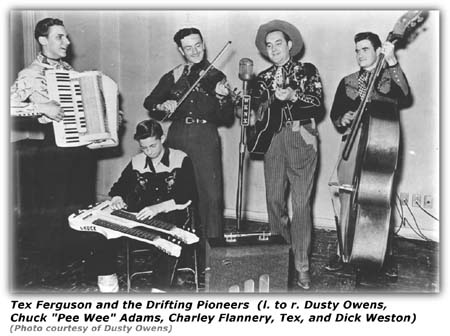
While in Saginaw, I decided I needed a complete stage name. Up to this time, I was billed as "Dusty and his accordion." The guys in the band helped by making suggestions from time to time, but nothing rang the bell. Finally, I saw a street named "Owens," and I put that together with "Dusty." "Dusty Owens," hey, that sounds pretty good. I told Tex about it and from that time on, he introduced me as "Dusty Owens and his accordion!" It wasn't until ten years later that I had the name changed legally. It wasn't unusual for an entertainer to come up with a "stage name." It was done all the time in Hollywood. Herein lies a cute story. At the beginning of WWII, Gene Autry, "the number one cowboy," went into the service creating a void for Republic pictures. To replace Gene and to build a new "number one cowboy," they advertised for anyone to come out and audition for the job. The criteria included "riding, roping, gun-slinging and singing." And, of course, you had to be photogenic. The man that won out was Leonard Sly, one of the Sons of the Pioneers. Even though Leonard was from Ohio, he had taken on a great western presence and could ride and rope with the best of them. And, he could handle a gun real well and was very handsome. The problem was the name, Leonard Sly; the number one cowboy just wouldn't sell! So, they change his name to Roy Rogers! The rest is history! WKNX was like a lot of stations that provided bands an opportunity to perform regularly. The musicians were not paid by the station, but played to build up their reputation and a following. The money was made on personal appearances. To find a station that would pay a salary too was a great bonus. Tex found that special station in August. It was KFEQ in St. Joseph, Missouri. They wanted the entire band and were willing to pay something like $25 a week to each member. Tex probably got more as the leader. I was ecstatic. This was an opportunity to leave the state for the first time and play on a station and get paid! The four Drifting Pioneers played their first show over KFEQ on September 6th. I had just celebrated my 18th birthday. We played a couple of showdates very soon and settled into a routine, which included a daily show. One of the first things I did was to visit the little house in which Bob Ford shot Jesse James. It was very interesting and it captured my imagination immediately. I read everything I could get my hands on, that was written about the James boys. Also, I learned that St. Joseph was the beginning of the famous Pony Express route that went all the way to California. On September 18th the town celebrated "Pony Express Roundup" and featured Hopalong Cassidy in their parade. I took pictures of him which are in my scrapbook. I really enjoyed working for Tex Ferguson. He was from Waco, Texas, but had entertained in many places, including the Renfro Valley show in Kentucky. He was mild-mannered and a good singer. But fate had something else planned for Dusty Owens. After just two weeks on the air, one afternoon following the radio show, I received a telephone call from Glenn Harris, Program Director of KMA, Shenandoah, Iowa. He asked me, "How would you like to come to KMA and join our staff?" I was stunned. I told him that I hated to leave Tex. Then, he said the magic words, "I'll double your salary and pay your bus fare to Shenandoah." I accepted but told Glenn I wanted to give Tex two weeks notice. He agreed. Two weeks later I was on my way to Shenandoah, which was about 125 miles north of St. Joseph, located in the southwest corner of Iowa.
Studio A was quite unique. It was about 60 feet square and actually formed a stage for an auditorium. A heavy thick sliding glass window separated the studio/stage from the 600-seat auditorium. This glass window could be opened to present a show, or it could remain closed, draped with a thick curtain on the inside to make it more conducive for studio sound. The musical staff was well used. The Blackwood's Quartet opened the station at 5:15 AM and did three more shows during the day. Bob Stotts had two fifteen minute programs daily (I backed him up on one). Mac and Jeanie had two shows daily (I backed them up on one). I worked a show at noon called "The Stump Us Gang." People would send in titles of songs trying to stump us. They got a prize if they did. It was a fun show. There were other shows during the afternoon as well. No D.J.'s, all live talent!
I spent a good deal of my practice time singing songs with a borrowed guitar. I guess it started to sound pretty good judging by the comments around the studio. Ike Everly especially was encouraging and told me I should stay with it. Finally, I got up enough nerve, with Ike's urging, to ask P.D. Glenn Harris to give me a radio show. After listening to me one day, he said he would give me a 15-minute slot on Saturday mornings. Ike was so pleased he agreed to back me up with his electric guitar. This was a real sacrifice since Saturday was his day off. It wasn't long before the fan mail started to come in. That encouraged me more. Also, I began singing more solos on the personal appearances. Since I was not recording my own material yet, I did like every other aspiring singer. I learned the songs that I enjoyed hearing from those who where already on record, like Eddy Arnold, George Morgan, Hank Williams, Ernest Tubb, Jimmy Dickens, Hank Snow and Marty Robbins. Here are some of the songs: "I'm Free At Last," "Bouquet Full of Roses," "I'll Hold You In My Heart," Candy Kisses," "A Castle In The Sky," "A Heart Full of Love," "A Petal From A Faded Rose," "Lovesick Blues," "All Alone In This World," "Almost," "Anytime," and "A Fool Such As I." You can see that I was becoming a "ballad" singer. I also sang some of the real old-timers like, "Sweeter Than The Roses," "As Long As I Live," "Tragic Romance," "Foggy River," "Breeze," "Silver Haired Daddy of Mine," and "Molly Darling." The Everlys sort of took me into their family. I was an 18-year old a thousand miles away from home. Margaret occasionally cooked a chicken dinner on Sunday and had Ike invite me over for the meal and the day. It was fun wrestling with Donnie and Phil, who were 10 and 12 respectively, or romping through the cornfield playing hide and seek. They were great kids. I was so proud of them later when they hit it big with their Columbia records. Besides playing straight lead guitar, Ike could play the same style as Merle Travis and Chet Atkins. Ike liked to tell the story of how he beat Merle in a talent contest in Harlan County, Kentucky. Of course, I never heard Merle's side, but I don't doubt one minute that it's true. Ike also got us tuning into KWTO in Springfield, Missouri to listen to a young up-and-comer named, Chet Atkins. Chet was fantastic even then in 1948. Of course, this was before he went to Nashville and before he made records. The story went around that he practiced eight hours a day and wouldn't take time off to eat a lunch normally. Supposedly, his wife would bring him a sandwich and a glass of milk, and he just continued to practice. I don't doubt that one either.
Mac and Jeanie landed a recording contract and cut their first recording for Red Barn Records out of Kansas City, Missouri. Record 3014-A was entitled "Remember Me," and 3014-B was "I'm Waiting Still." They asked me to back them up with the accordion, so this was my first recording also.
It was a thrill for me to play on some of the same shows with the original Blackwood Brothers Quartet. Roy Blackwood, who was the oldest of the family, formed the quartet in 1934 in Choctaw County, Mississippi. Roy, Doyle and James and later, R.W. comprised the original quartet. They came to KMA in Shenandoah in 1940. Besides appearing several times a day on the radio station, they soon were in great demand singing for churches, schools, and camp meetings everywhere. The quartet's big break came in 1954, when they appeared on Arthur Godfrey's Talent Scouts on CBS. They won first place and landed a recording contract with RCA. They became the first gospel group to sell a million records. The Blackwoods honored me in 1949 by asking me to join them as their accordionist. They had lost their piano player and were without accompaniment. However, I had my sights set on being a singing star someday, playing the guitar to my own accompaniment. I turned down the offer with mixed emotions (about 80/20). I'll never forget that offer. The Blackwoods were dear people and I will always cherish them in my heart. I bought my first automobile in Shenandoah, a 1934 Ford four-door sedan. I was very proud of the car and told the guys that I would drive on the next personal appearance. When they saw the car, they hesitated but finally piled in. Nothing could pass it on the road. The fact was that it burned a quart of oil to every 10 gallons of gasoline, and the reason nobody could pass us on the road is that THEY COULDN'T SEE THE ROAD FOR ALL THE SMOKE. That was the first and last time the guys would go with me. They encouraged me to take the car back to the dealer and get my money back. After about a week I decided to follow their advice. I returned the Ford and got my $150 back! Some time later, Ike was planning to buy a new Chevrolet and offered me his 1941 Chevrolet so I bought it. Mainly, because it didn't smoke at all! Betty got a job working at Lawson's Jewelers, which helped us to have a little more spending money. There were two movie houses in Shenandoah, the Mayfair and the State. They changed showings on Mondays and Fridays, always with double features. Betty and I loved the movies (and we still do) and we spent a good deal of time going to the movies. After all, what else could you do in this small, rural town? It was great to have Betty with me now. We set our wedding date for July 2, 1949. When I notified them at the radio station, they featured us on the cover of the KMA Guide, a monthly publication of the station.
"Cutting a transcription" was a literal process. Each record was about 18 inches in diameter, a metal base covered with vinyl. As the turntable revolved, an arm holding a cutting needle was lowered onto the record, resulting in grooves being cut into the vinyl. Sound waves were deposited on both sides of the grooves. Of course, there was no room for mistakes. In other words, mistakes were recorded as well. We set up a schedule to record five Mother's Best Flour shows on Tuesdays and five Lassie Feeds shows on Thursdays. We tried to stay a couple of weeks ahead of their scheduled air times. This tied us up about four hours on each day. The rest of the time was our own, and for personal appearances which was about nil right now. Sounds too good to be true, doesn't it. It was! Everything fell through and the project ended by November 25th. The money stopped coming in and we had to do something in a hurry. After making some unsuccessful attempts at landing a radio job in the area, I called Clarence Clark at the Honolulu Conservatory of Music in Flint. He said, "Funny you should call, I need an accordion teacher now." I told him that I would be in Flint in a week. We arrived home on Sunday, December 4th. My mother had spread the word that we were coming home. Would you believe that meeting us that Sunday were Chuck Adams, Bob Cooley, and Gabby Burrows, and we jammed the night away! While I taught accordion students at the Conservatory, I was getting re-acquainted with the musicians in Flint. I worked some with Max Henderson and Sonny Sexton at the Wagon Wheel and Bob Haines at the Yellow Jacket. Sonny owned the WagonWheel for some years before my old friend Gabby Burrows, who played bass in my first band on WWOK in 1947, bought him out. He still owns it today! The gig at the Jacket was six nights a week. I soon tired of that and quit. I put together a trio and worked at Mike's Tavern, which lasted about six months. I even took a strolling gig with Earl Vincent, the violin teacher from the Conservatory. We strolled from table to table at this fancy supper club and played requests. We played everything from the latest pop songs to country. We even played semi-classical. Earl was good; he could play anything. But I was growing restless and longed for radio work again. By the summer of 1951 I was ready to hit the trail again. Dad helped me to purchase a new 1950 Buick at factory price so I had the right car for the road now. Boy, that was a beautiful car; a high polished maroon color with a lot of glistening chrome. For over a year now I was gathering my band together to leave Flint. Chuck Adams played steel (he was 16 now); Bob Cooley played rhythm guitar and his brother, Dick Cooley played bass. Both of them were married but their wives were willing to stay home until we found some work somewhere. Of course, Betty was in complete agreement and would wait at home for me to send for her also. Chuck was single. Bob was married to Phyllis and they had three children. Dick's wife was Shirley and they had one daughter. I always liked Iowa for country music. The people were rural and enjoyed that type of music. They loved to square dance. Also, I felt there were a number of radio stations that had live entertainment. So, on Monday, October 1, 1951 the four of us piled into that 1950 Buick with our instruments and luggage and headed for Iowa to seek our fortune and fate! Read Part 2
Related Web Links
Sound Sample—(YouTube Video Format)
Appearance History This Month
Get The Music
|
||||||||||||||||||||||||||||
| Printer Friendly Version |
|
Recordings (78rpm/45rpm)
| ||||||||||||||||||||||||||||||||||||||||||||||||||||||||||||||||||||||||||||||||||||||||||||||||||||||||||||
Hillbilly-Music.com
Yes, Hillbilly Music. You may perhaps wonder why. You may even snicker. But trust us, soon your feet will start tappin' and before you know it, you'll be comin' back for more...Hillbilly Music.
Hillbilly-music.com ...
It's about the people, the music, the history.
|
Copyright © 2000—2023 Hillbilly-Music.com
|
||||
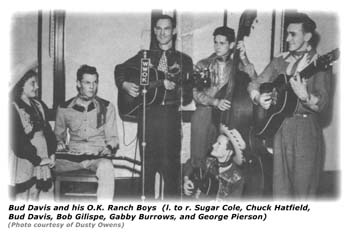 Bud Davis was a swell guy and the band was very good. George
Pierson played lead guitar, Darrell "Gabby" Burrows played bass, and
Chuck Hatfield played steel guitar, but he was leaving to go
to Texas. I took his place. We did a lot of Sons of the Pioneers
numbers like, "Cool Water," and "Riding Down the Canyon." Bud
did most of the solos, "Born To Lose," "Have I Told You
Lately That I Love You," etc. The biggest show we appeared in
was "The Chesaning Showboat" in Chesaning, Michigan. Governor
Ken Siglar attended. It was exciting. I bought a couple
of western shirts and pants, and my first pair of cowboy
boots. Mom sewed on a flower design in sequences in the yoke
of the shirts, and I added a neckerchief around my throat. I felt
like a real cowboy. My uncle Charley called me
"a drug store cowboy" which did nothing for my ego.
Bud Davis was a swell guy and the band was very good. George
Pierson played lead guitar, Darrell "Gabby" Burrows played bass, and
Chuck Hatfield played steel guitar, but he was leaving to go
to Texas. I took his place. We did a lot of Sons of the Pioneers
numbers like, "Cool Water," and "Riding Down the Canyon." Bud
did most of the solos, "Born To Lose," "Have I Told You
Lately That I Love You," etc. The biggest show we appeared in
was "The Chesaning Showboat" in Chesaning, Michigan. Governor
Ken Siglar attended. It was exciting. I bought a couple
of western shirts and pants, and my first pair of cowboy
boots. Mom sewed on a flower design in sequences in the yoke
of the shirts, and I added a neckerchief around my throat. I felt
like a real cowboy. My uncle Charley called me
"a drug store cowboy" which did nothing for my ego.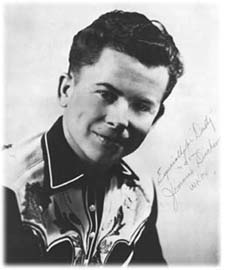
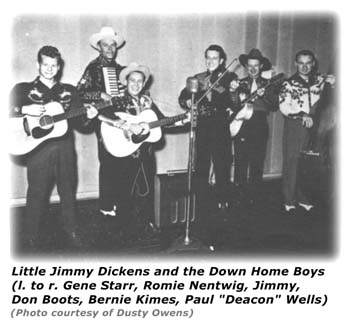
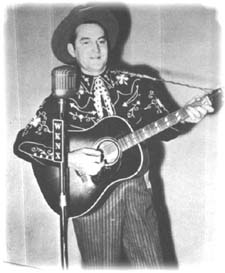
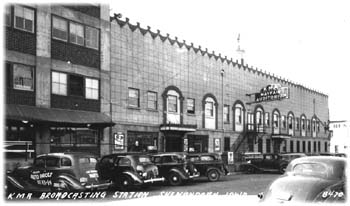 KMA was owned by the Earl May Seed Company and blanketed about five states.
Earl May had built a fortune selling seed in bulk and in small packages
through catalogs and stores in the Midwest. The station was very
popular with the people, most of who were rural. The musical staff
boasted about 30 members (all paid), who made radio appearances
throughout the day (I had four shows daily). The original
Blackwood Brothers Quartet had their first great success at KMA.
The rest of the staff included Ike Everly, lead guitarist and father
of Donnie and Phil (the Everly Brothers of later fame); Mack & Jeanie
Sanders, husband and wife duet team; Yodlin' Bob Stotts; Eddie Comer,
clarinet; Buddy Morris, fiddle and bass; Steve Wooden, soloist;
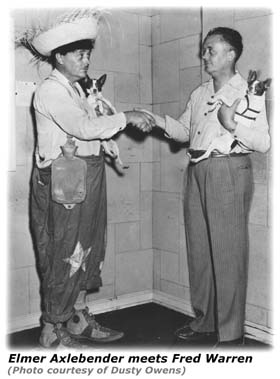
Judy and Jean, a sister duet; Fred Warren, trumpet, who doubled
as rube, "Elmer Axlebender"; and Marge Parker, soloist. I replaced
Jerry Fronek who left KMA for parts unknown to this author.
KMA was owned by the Earl May Seed Company and blanketed about five states.
Earl May had built a fortune selling seed in bulk and in small packages
through catalogs and stores in the Midwest. The station was very
popular with the people, most of who were rural. The musical staff
boasted about 30 members (all paid), who made radio appearances
throughout the day (I had four shows daily). The original
Blackwood Brothers Quartet had their first great success at KMA.
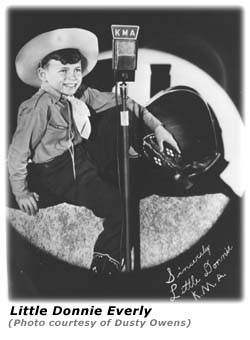
The rest of the staff included Ike Everly, lead guitarist and father
of Donnie and Phil (the Everly Brothers of later fame); Mack & Jeanie
Sanders, husband and wife duet team; Yodlin' Bob Stotts; Eddie Comer,
clarinet; Buddy Morris, fiddle and bass; Steve Wooden, soloist;
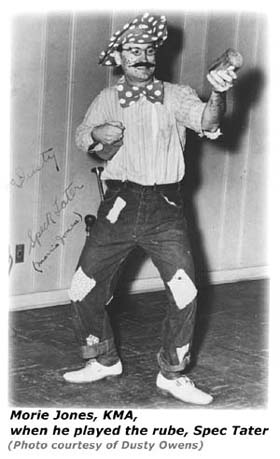
Judy and Jean, a sister duet; Fred Warren, trumpet, who doubled
as rube, "Elmer Axlebender"; and Marge Parker, soloist. I replaced
Jerry Fronek who left KMA for parts unknown to this author.

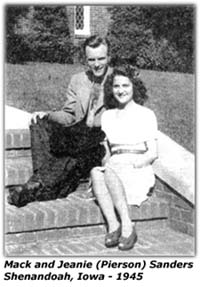 Mack and Jeanie Sanders were from Montgomery, Alabama. (Editor's Note:
Jeanie was a part of a musical family. Her brothers were Jimmie Pierson - of Jimmie
and Dick the Novelty Boys fame and Willie Pierson and also had a sister
Cora Deane who was part of the Novelty Boys act before passing away
in 1949). They sang a close harmony duet that was beautiful. I backed them up every
morning at 10:15, "It Helzberg's Time." Mac was a great promoter and
handled the bookings for our personal appearances.
Mack and Jeanie Sanders were from Montgomery, Alabama. (Editor's Note:
Jeanie was a part of a musical family. Her brothers were Jimmie Pierson - of Jimmie
and Dick the Novelty Boys fame and Willie Pierson and also had a sister
Cora Deane who was part of the Novelty Boys act before passing away
in 1949). They sang a close harmony duet that was beautiful. I backed them up every
morning at 10:15, "It Helzberg's Time." Mac was a great promoter and
handled the bookings for our personal appearances.
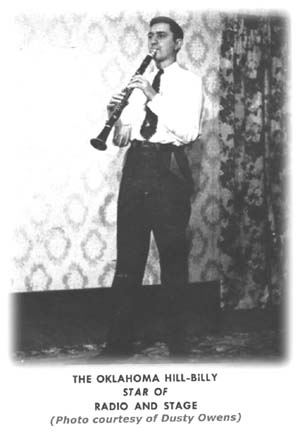 Eddie Comer was billed as the Oklahoma Hillbilly clarinet player.
He could play anything from pop and jazz to country and
western swing. He could play harmony to anything,
and often we had arrangements that called on his expertise. Eddie
loved the music of Bob Wills, Johnny Lee Wills, Spade Cooley, and Tex
Williams, and taught me a lot about western swing. When
my Betty moved down from Michigan in November, Eddie, his wife Gladys,
Betty and I had some great times together.
Eddie Comer was billed as the Oklahoma Hillbilly clarinet player.
He could play anything from pop and jazz to country and
western swing. He could play harmony to anything,
and often we had arrangements that called on his expertise. Eddie
loved the music of Bob Wills, Johnny Lee Wills, Spade Cooley, and Tex
Williams, and taught me a lot about western swing. When
my Betty moved down from Michigan in November, Eddie, his wife Gladys,
Betty and I had some great times together.
 Betty and I moved to Omaha on Saturday, October 22, and we began
cutting our transcriptions on Tuesday. The recording studio was in
the house of Terry Moss, who lived in Council Bluffs. His recording
equipment was located in his basement, but the microphone was upstairs
in his living room. Surprisingly, he got a good sound out
of this setup.
Betty and I moved to Omaha on Saturday, October 22, and we began
cutting our transcriptions on Tuesday. The recording studio was in
the house of Terry Moss, who lived in Council Bluffs. His recording
equipment was located in his basement, but the microphone was upstairs
in his living room. Surprisingly, he got a good sound out
of this setup.