|
 |
|||||||||||||||||||||||||||||||||||||||||||
|
About The Artist
Ms. Barthel tells the readers that Bill's radio performing career started at a station in Houston, Texas - KTHT - back in 1944. She mentions he had been at a few other stations since that time and had moved to KSOO in Sioux Falls, South Dakota. A 1949 article tells us that Bill was just 16 then and had won an amateur contest at the Joy Theatre. A representative from KTHT happened to be present and decided to give Bill his first radio job. In remembering that episode, Bill was quoted, "My Mother thought for sure I was dying, and I can't say what the old man said."
During this part of his career, Texas Bill got to meet his hero so to speak - Ernest Tubb during one of Ernest's personal appearances. In fact, Norma Barthel mentions he was quite good about promoting Ernest and his records and even mentions that he was a "...young fellow with a voice that sounds remarkably like Ernest Tubb, especially when singing one of Ernest's songs." In the latter part of 1946, Floy Case reported in her column that he had a six piece western band and doing personal appearance in the Missouri and Kansas area. She noted that Bill was "...doing all right for himself in this hillbilly biz." She also mentions that he had penned a couple of new tunes, "The Rose of My Heart" and "Who's Gonna Love Me Now".
But by the end of 1946, his career had taken him to Memphis, Tennessee - based on a letter to the editors of National Hillbilly News that listed his PO Box as being in Memphis. In fact, the January 1947 issue reports in Arlie Kinkade's column, "This, That 'n the Other" that he was working at WHHD. Interestingly, we found another article in the December 1946 issue of Mountain Broadcast and Prairie Recorder by one of country music's earliest journalists, Floy Case, who tells readers that Norma Winton, president of Ernest Tubb's Fan Club and publisher of the newsletter, Melody Trails, had started her own band and it was called, the "Melody Trail Riders". The "...singing emcee..." Ms. Case tells us was Texas Bill Strength, who she described as "...a young fellow who seems to be going places in a hurry." Bill and the group were playing dates in the eastern Oklahoma and western Arkansas areas.
A 1951 article in Cowboy Songs magazine tells us that Bill had gone back to Houston and had a daily program over radio station KATL. In addition to his disc jockey chores, he immersed himself with personal appearances in the Houston area. Around that time, Foremost Dairies offered Bill a fifteen month contract with a new 5,000 watt station, KLEE. However, the contract did not deter his night club work which included the Houston Hoedown Club along with a nightly broadcast over station KNUZ, another Houston station. September of 1949 found Bill in Birmingham, Alabama doing daily radio programs at WRBC, which was a bit of a network of 37 stations throughout Alabama.
In 1950, Bill's career took another turn, this time as part of the staff for the labor organization, CIO on January 15, 1950. During that time, he was doing radio transcriptions with George Baldanzi, then Executive VP of the Textile Workers Union of America and National Director of the CIO Organizing Committee. The transcriptions were aired over 126 stations. At that time, the CIO had over 6.5 million members, so Texas Bill and his record label, 4-Star Records, took advantage of that and created a slogan for Bill, "...the Boy with 6 and a half million sponsors."
Some of the more well known venues he appeared at were the Palmer House in Chicago, the "world's largest auditorium" in Atlantic City, New Jersey, the Hotel Utah in Salt Lake City, Utah; the National Training School for Boys, Washington, DC; the Hudson Manor in Tampa, Florida and also KWKH's Louisiana Hayride in Shreveport. By 1951, he had appeared five times on WSM's Grand Ole Opry, appearing with his friend Ernest Tubb. In 1951, he was living in Atlanta, Georgia with his wife and two children. He had made several appearances over WAGA-TV in Atlanta. A June 1954 article mentions that Bill had a daily show from 11:00am to 12:45pm over radio station WEAS in Decatur, Georgia. In another summer 1954 article in Country Song Roundup's Fifth Anniversary Issue which featured spotlights on disc jockeys from around the country, they offered the reader a couple of quotes attributed to Texas Bill that give us perhaps some insight into music and his career: "...I have taken it for granted that it is the only business that I should be in. Within these ten years, I have been associated with many types of people who tell a story. Some tell their story in a speech, others in books, and yet, there are people who can better tell a story in song. ... and I guess that's why I've been inspired to since my boyhood, to tell my story in a song.
In 1956, he was doing tour dates in the Kentucky and Ohio areas, appearing with such acts as The Carlisles, Ferlin Husky, Martha Carson among others. A May 1956 article appears to be promoting his efforts with Capitol Records at the time along with the inauguration of the new country music programming at KEYD. The station's staff at that time also included another country singer, Johnny "T" (Johnny Talley). The article also mentions that Bill's wardrobe for his personal appearances was valued at over $3,200. A May 1956 article mentions that Bill had appeared on the Midwestern Hayride over WLW in Cincinnati, Ohio as well as on programs hosted by such stars as Pee Wee King and Red Foley (the Ozark Jubilee). That same article told readers that in a voters poll, Bill ranked number 50 out of over 1,800 disc jockeys nationwide.
He appeared on the cover of the June 1954 issue of Cowboy Songs, as one of three artists featured in the issue. In May 1956, he was the featured artist on the cover of Cowboy Songs. Country & Western Jamboree magazine featured him on the cover of their July 1956 issue but only devoted a few short paragraphs to Bill inside but did at least mention he was the number one rated Disc Jockey in the Minneapolis-St. Paul metropolitan area. In 1990, Texas Bill Strength was elected to the Country Music Disc Jockey Hall of Fame. In August of 1973, Texas Bill Strength was asleep in a car while driving with a friend on a promotional tour. Their car left the road and flipped several times. Texas Bill was paralyzed from the waist down and later slipped into a coma. He passed away in October 1973. Credits & Sources
Sound Sample—(YouTube Video Format)
Get The Music
|
|||||
| Printer Friendly Version |
|
Recordings (78rpm/45rpm)
| ||||||||||||||||||||||||||||||||||||||||||||||||||||||||||||||||||||||||||||||||||||||||||||||||||||||||||||||||||||||||||||||||||||||||||||||||||||||||||||||||||||||||||||||||||||||||||||||||||||||||||||||||||||||||||||||||||||||||||||||||||||||||||||||||||||||||||||||
Hillbilly-Music.com
Yes, Hillbilly Music. You may perhaps wonder why. You may even snicker. But trust us, soon your feet will start tappin' and before you know it, you'll be comin' back for more...Hillbilly Music.
Hillbilly-music.com ...
It's about the people, the music, the history.
|
Copyright © 2000—2023 Hillbilly-Music.com
|
||||
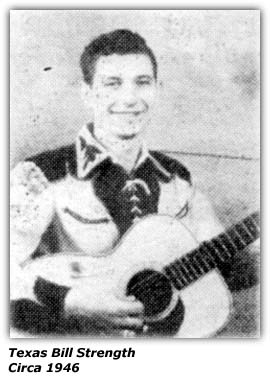 The earliest mention we've found of "Texas" Bill Strength was in the May 1946
issue of National Hillbilly News in a brief writeup by long-time Ernest Tubb Fan Club
President, Norma Winton. At that time, he had just finished working at KFEQ in
St. Joseph, Missouri. His popularity was such over KFEQ that he was being sponsored
over 17 other radio stations at that time.
The earliest mention we've found of "Texas" Bill Strength was in the May 1946
issue of National Hillbilly News in a brief writeup by long-time Ernest Tubb Fan Club
President, Norma Winton. At that time, he had just finished working at KFEQ in
St. Joseph, Missouri. His popularity was such over KFEQ that he was being sponsored
over 17 other radio stations at that time.
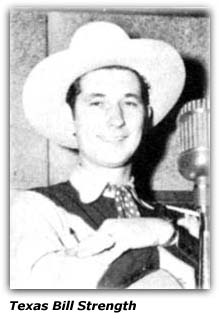 In those early days, Texas Bill was also writing tunes such as "There's Always Two to Blame",
"I'm Lonely Since You've Gone" and "You've Left Me Behind" were several of the tunes
Ms. Barthel tells the readers he had written up to that point and "...many more."
In those early days, Texas Bill was also writing tunes such as "There's Always Two to Blame",
"I'm Lonely Since You've Gone" and "You've Left Me Behind" were several of the tunes
Ms. Barthel tells the readers he had written up to that point and "...many more."
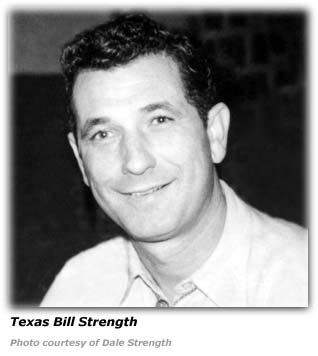 Norma wrote of Texas Bill again in the July 1946 issue of National Hillbilly News
in two of her columns - one was "Just Driftin'" where she notes that he was working
in Colorado and making personal appearances throughout the area. In her "Radio
Programs and Cowboys" column in the same issue, she provides a snippet of the type
of tunes he was singing back then. She mentions that Texas Bill had presented her
with a special recording, that became a treasured memento to her. He recorder her
favorite tune at the time, "Yesterday's Tears" and then followed that up with
several of his own song writing efforts - "Please Don't Ever Forget Me" and "Louisiana
Lou". But he may have been longing for his southern roots as Norma notes he was
talking about the cold weather and how hard it was for a southern boy to cope with
it. While he may have complained about it, he was doing well at the time and was the
envy of Norma being able to work there for she was a native of the state.
Norma wrote of Texas Bill again in the July 1946 issue of National Hillbilly News
in two of her columns - one was "Just Driftin'" where she notes that he was working
in Colorado and making personal appearances throughout the area. In her "Radio
Programs and Cowboys" column in the same issue, she provides a snippet of the type
of tunes he was singing back then. She mentions that Texas Bill had presented her
with a special recording, that became a treasured memento to her. He recorder her
favorite tune at the time, "Yesterday's Tears" and then followed that up with
several of his own song writing efforts - "Please Don't Ever Forget Me" and "Louisiana
Lou". But he may have been longing for his southern roots as Norma notes he was
talking about the cold weather and how hard it was for a southern boy to cope with
it. While he may have complained about it, he was doing well at the time and was the
envy of Norma being able to work there for she was a native of the state.
 In January of 1947, Ms. Case wrote that Bill was one fellow that "...gets around", going
from Texas to South Dakota and Colorado. She mentions she had known he was working
as part of Norma Winton's band, the Melody Trail Riders out of Ft. Smith, Arkansas
but had since formed his own band, the "Ranch Ramblers" and was working regularly
at the Rainbow Gardens in Memphis, Tennessee. She, like many of the columnists back
then who also dabbled in song writing, then segues into mentioning that Bill had been
plugging a song she had written with Jimmie Davis, "I'm Beginning to Forget You" that
had also been recorded by Ernest Tubb. A 1952 article mentions that in 1947, Bill
toured with several large road shows then and did stints at KMYR in Denver, KSOO in Sioux Falls,
KMA in Shenandoah, Iowa and KRLD in Dallas, Texas.
In January of 1947, Ms. Case wrote that Bill was one fellow that "...gets around", going
from Texas to South Dakota and Colorado. She mentions she had known he was working
as part of Norma Winton's band, the Melody Trail Riders out of Ft. Smith, Arkansas
but had since formed his own band, the "Ranch Ramblers" and was working regularly
at the Rainbow Gardens in Memphis, Tennessee. She, like many of the columnists back
then who also dabbled in song writing, then segues into mentioning that Bill had been
plugging a song she had written with Jimmie Davis, "I'm Beginning to Forget You" that
had also been recorded by Ernest Tubb. A 1952 article mentions that in 1947, Bill
toured with several large road shows then and did stints at KMYR in Denver, KSOO in Sioux Falls,
KMA in Shenandoah, Iowa and KRLD in Dallas, Texas.
 In late 1949, Bill's career had taken him back to Houston, Texas. Tex Moon
wrote in his "Southwestern Round-Up" column for National Hillbilly News that
Bill was one of the mainstays at a new venue in Houston where it was said, "The
Best Bands of All Come to Hillbilly Hall" along with others such as
Floyd Tillman, Hank Lockwood, Leon Payne, Benny Leaders, Pete Hunter, the Texas
Cowboys, Woody Carter and others.
In late 1949, Bill's career had taken him back to Houston, Texas. Tex Moon
wrote in his "Southwestern Round-Up" column for National Hillbilly News that
Bill was one of the mainstays at a new venue in Houston where it was said, "The
Best Bands of All Come to Hillbilly Hall" along with others such as
Floyd Tillman, Hank Lockwood, Leon Payne, Benny Leaders, Pete Hunter, the Texas
Cowboys, Woody Carter and others.
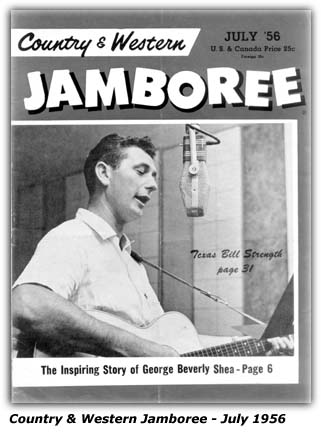 The 1951 Cowboy Songs article notes that Bill was such a hit with his CIO bit that
he logged over 57,000 miles of traveling on tours, personal appearances as well
as visiting those in hospitals and institutions as well as hi attendance at union
meetings and conventions for the CIO. Impressively, it was said that he entertained
upwards of a quarter million people at each of those conventions. Like many artists,
Bill shared the stage with many of the mainstays of country music in that era. But Bill
also got to entertain some well-known political figures of the era due to his work
with the CIO, including Vice President Alben Barkley, Senator Hubert H. Humphrey
of Minnesota; Congressman Christopher of Missouri and Maurice Tobin, Secretary of Labor.
The 1951 Cowboy Songs article notes that Bill was such a hit with his CIO bit that
he logged over 57,000 miles of traveling on tours, personal appearances as well
as visiting those in hospitals and institutions as well as hi attendance at union
meetings and conventions for the CIO. Impressively, it was said that he entertained
upwards of a quarter million people at each of those conventions. Like many artists,
Bill shared the stage with many of the mainstays of country music in that era. But Bill
also got to entertain some well-known political figures of the era due to his work
with the CIO, including Vice President Alben Barkley, Senator Hubert H. Humphrey
of Minnesota; Congressman Christopher of Missouri and Maurice Tobin, Secretary of Labor.
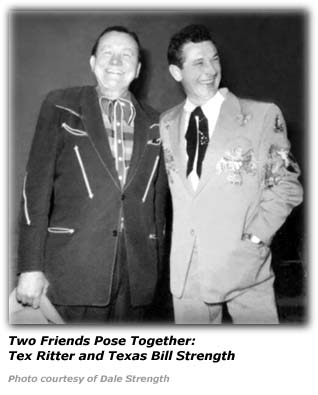 Around 1953 or so, Bill was doing his recordings on Capitol Records.
He was being featured over station KEYD (later known as KEVE) out of Minneapolis, MN
and did personal appearances across the country.
Around 1953 or so, Bill was doing his recordings on Capitol Records.
He was being featured over station KEYD (later known as KEVE) out of Minneapolis, MN
and did personal appearances across the country.
 The December 1956 issue of Country & Western Jamboree included the results of various fan polls
they had taken. One result was that Texas Bill Strength finishing number three behind
such other disc jockey legends as T. Tommy Cutrer and Don Larkin as "Favorite Local Radio
Disc Jockey". That list also included other legends that would be in the Country Music
Disc Jockey Hall of Fame, Randy Blake and Bill Mack.
The December 1956 issue of Country & Western Jamboree included the results of various fan polls
they had taken. One result was that Texas Bill Strength finishing number three behind
such other disc jockey legends as T. Tommy Cutrer and Don Larkin as "Favorite Local Radio
Disc Jockey". That list also included other legends that would be in the Country Music
Disc Jockey Hall of Fame, Randy Blake and Bill Mack.
 British Archives of Country Music
 British Archives of Country Music