
|
 |
|||||||||||||||||||
|
About The Artist
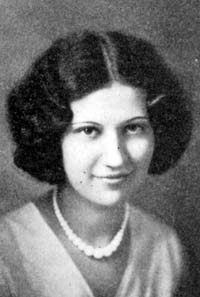
Prairie Farmer noted in their 1935 magazine article on Sophia that the family's journey to the United States involved a long train trip and eventually a sea voyage to reach their new home. While she grew up as a typical American girl, she also learned the language of her forefathers and the traditional songs of her parents' homeland. Her father played a number of musical instruments and was a member of several choral groups. When she was just ten years old, Sophia took up playing the reed organ. A couple of years later, she would acompany her father at various church and club functions where he frequently appeared as a singer. Audiences were also treated to father and daughter duets. A 1935 article notes one of her biggest thrills in her young life was when she graduated from the Chopin grammar school. She was part of a graduating class production number where they were staging a 'mock wedding'. She had to do a solo number before an audience of thousands in the school auditorium. She recalled that her vocal solo number was "At Dawning". While it was the first time in front of a microphone for her, the thrill of the experience helped her rise above any nervousness she may have felt then.
Around this time, she applied went to an employment agency and was sent to apply for a job with WLS's circulation department. She found work at WLS as a stenographer and assistant to William Jones in the Prairie Farmer offices. When she was hired, no one at WLS knew she could sing. WLS discovered her vocal talent when she was overheard singing Christmas Carols with her co-workers who had formed a chorus at the office. It didn't take long for the then WLS orchestra leader, Herman Felber, to notice her distinvctive voice. That apparently led to her getting some musical and vocal training. Sophia had hopes of getting four years of vocal education while in high school. But she had to set aside those dreams as family economics required her to leave high school after only two years to find a job. But once she found work, she took up her vocal training again with private teachers, including Mrs. Herman Felber, Jr.
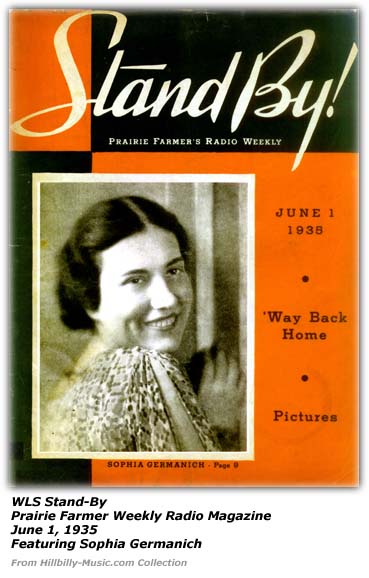
The WLS Family Album of 1934 notes that she performed a tune at the World's Fair called "With A Song In My Heart" and by the time she had finished that song, it was in the midst of a pouring rainstorm. In another edition, they noted that Sophia's voice was such that it was felt she put her whole soul into the songs she sang. After she started singing, Burridge D. Butler, Prairie Farmer publisher and G. A. Holt, circulation manager agreed that it would be better if Sophia "moved upstairs to WLS" to work in the music department. Here, they discovered her musical knowledge where between broadcasts, she could be found in the music library working on the daily music schedules. She appeared on numerous broadcasts over WLS. The old weekly publication of WLS Stand-By magazine provides a glimpse of what the radio audiences would hear. In June of 1935, she was appearaing at 9:15am on the "Household Parade" show, wich featured her as soprano along with John Brown piano, Ralph Waldo Emerson on the organ. The Dean Brothers (Eddie Dean, the famed cowboy singer was one of them.) did vocal and instrumental numbers. Jack Holden did the announcing chores and Howard Chamberlain was doing some news reporting. Mary Wright was the home adviser. Also in June of 1935, she was on at 10:30am for a 15-minute spot with the WLS Rangers.
In 1937, she was being heard with the Hometowners Quartet on the Melody Parade program over WLS. She was also appearing occasionally on the Homemakers' Hour program. Sophia's granddaughter relates a story that Sophia told her of how she met her future husband at WLS. Sophia thought he (Bob McElwain) was cute and wanted to get his attention. She tossed a book up in the air (over a cubicle wall) where Robert was talking with some other people in the office. The book ended up hitting him on the head. That's how they met. And the two of them laughed about it for years. In the summer of 1937, she married Bob McElwain who was working in the WLS business department as a salesman for the radio station. A daughter, Linda, was born eleven years later in 1948. Back in those days, WLS seemed to encourage the romances and eventual marriages among its staff. It was something they would often report in their publications. Sophia was a regular columnist in the old WLS Stand-By magazine with her "Notes From The Music Library" column. John Lair had originally started the column. Here, she would help WLS listeners connect with other fans trying to find various music and lyrics to favorite songs.
When 1939 rolled around, John Lair had decided to leave WLS and move to radio station WLW in Cincinnati, Ohio. The Crosley broadcasting organization was not shy about luring popular talent from other stations and would often offer them more in the way of wages. John formed the Renfro Valley Barn Dance troupe and he enticed Sophia to join the cast as well in 1939. According to her granddaughter, Colleen, Sophia never talked about her famous history with the radio stations and her music career with the family. But Sohpia did keep her WLS Family Albums, pictures and letters tucked away. Colleen only learned of her grandmother's celebrity status in the last few years. Unfortunately Sophia battled Alzheimer's disease towards the end of her long life, diminishing her ability to recall more of her past before passing away. Sophia's granddaughter would like to learn more about her grandmother, Sophia Germanich. And would love to find a recording to hear her vocals. For those who may wish to share their memories or memorabilia or have a recording, please contact Colleen by email—Colleen Gerstein. Credits & Sources
|
| Printer Friendly Version |
Hillbilly-Music.com
Yes, Hillbilly Music. You may perhaps wonder why. You may even snicker. But trust us, soon your feet will start tappin' and before you know it, you'll be comin' back for more...Hillbilly Music.
Hillbilly-music.com ...
It's about the people, the music, the history.
|
Copyright © 2000—2023 Hillbilly-Music.com
|
||||
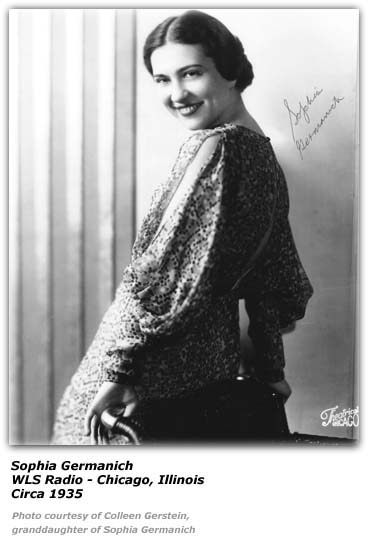
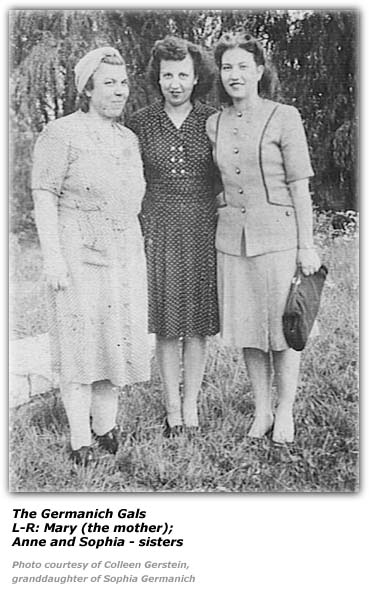
 Sophia Germanich was born in Prislop, Czechloslovakia. Her father George Germanich
would leave the country for a time to make enough money to send for his wife Mary and
their daughter Sophia. The family immigrated to the United States in 1912
and settled in Chicago, Illinois. One family memory from the immigration trip was
that Sophia's mother, Mary, was given a banana to give as a snack to her young
daughter. Mary had not seen a banana before. So she carefully cut out the seeds
in the center, not knowing if they were safe to eat, before giving the banana
to her daughter.
Sophia Germanich was born in Prislop, Czechloslovakia. Her father George Germanich
would leave the country for a time to make enough money to send for his wife Mary and
their daughter Sophia. The family immigrated to the United States in 1912
and settled in Chicago, Illinois. One family memory from the immigration trip was
that Sophia's mother, Mary, was given a banana to give as a snack to her young
daughter. Mary had not seen a banana before. So she carefully cut out the seeds
in the center, not knowing if they were safe to eat, before giving the banana
to her daughter.
 She started her radio career at the age of 16, appearing on radio station WORD (which
later became WCHI) in Chicago. She sang solos with a chorus
and as well as duet numbers with her father. Two years later saw her brother and
sister join them to become a family quartet.
She started her radio career at the age of 16, appearing on radio station WORD (which
later became WCHI) in Chicago. She sang solos with a chorus
and as well as duet numbers with her father. Two years later saw her brother and
sister join them to become a family quartet.
 Before joining WLS, she had taken some business school training and got some
office work experience before joinging WLS in the summer of 1929.
Before joining WLS, she had taken some business school training and got some
office work experience before joinging WLS in the summer of 1929.
 The Dinnerbell programs were on the air each weekday from 12:15pm to 1:00pm. The cast
of musicians appearing on the program each day varied, but one regular was Sophia Germanich.
She became known for doing the closing hymn on the Dinnerbell time show.
Some of the other acts appearing on the program in the first week of June 1935 included
the Hoosier Sod Busters, WLS Rangers, The Westerners, the Arkansas Woodchopper (Arkie),
the Flannery Sisters, Ralph Waldo Emerson on the organ and the WLS orchestra.
The Dinnerbell programs were on the air each weekday from 12:15pm to 1:00pm. The cast
of musicians appearing on the program each day varied, but one regular was Sophia Germanich.
She became known for doing the closing hymn on the Dinnerbell time show.
Some of the other acts appearing on the program in the first week of June 1935 included
the Hoosier Sod Busters, WLS Rangers, The Westerners, the Arkansas Woodchopper (Arkie),
the Flannery Sisters, Ralph Waldo Emerson on the organ and the WLS orchestra.
 In doing that column, she provided some publicity to a "Song Exchange Club" that
originated with J. G. Jones of Adolphus, Kentucky and Arlie Kinkade of Graysville, Ohio.
In the May 14, 1938 issue, she published the club's "Rules and Regulations". Anuual
Dues for the club were only 35 cents and were due each June. The club had a publication
called the "Song Exchange News" that featured news about the latest songwriting efforts
and occasional biographical articles on the artists of the day. This perhaps helped
set the stage for future publications such as the National Hillbilly News, of which
Arlie became a regular contributor with his column that was similar in focus - the
songwriting efforts and what songs were getting attention by the performing artists.
In doing that column, she provided some publicity to a "Song Exchange Club" that
originated with J. G. Jones of Adolphus, Kentucky and Arlie Kinkade of Graysville, Ohio.
In the May 14, 1938 issue, she published the club's "Rules and Regulations". Anuual
Dues for the club were only 35 cents and were due each June. The club had a publication
called the "Song Exchange News" that featured news about the latest songwriting efforts
and occasional biographical articles on the artists of the day. This perhaps helped
set the stage for future publications such as the National Hillbilly News, of which
Arlie became a regular contributor with his column that was similar in focus - the
songwriting efforts and what songs were getting attention by the performing artists.