|
 |
|||||||||||||||||||||||||
|
About The Artist
Lennie Aleshire ranked as one of country music's great novelty musicians and was also a noted comedian. A native of the Missouri Ozark region, Lennie spent part of his youth living with Creek Indians and as a teen-ager lost three fingers in a sawmill accident. This may have encouraged him to pursue a career in entertainment. He developed his musical skills at an early age. A 1946 article mentions he was playing the violin when he was just six years old, then he learned the guitar and banjo. He would continue learning musical instruments, becoming quite a versatile entertainer. Even more interesting is that he played the instruments by ear - he was said to be able to hear a tune once and was able to play it without having to hear a repeat of the tune. His gift of playing musical instruments was no small thing. It seems early on he was a part of a class in Dadeville, Missouri. Lennie had taken the class because he wanted to learn to read music as well. But after the instructor heard him play, watching him tuning the instruments for other students, the teacher took Lennie aside. He told him "Lennie, I can't teach you a thing, you had a gift given to you, I almost envy." Lennie attended various elementary schools in the different towns his parents moved to. Even then, he was developing his entertainment talents, always creating some stunt to amuse his school mates. This same 1946 article notes that Lennie was "...so busy with local entertaining making fair wages then at an early age he had no thoughts for more schooling as many at that time taught school on an eight grade certificate. Lennie's education has progressed by personal experiences. A good example of character rather than degree making a gentleman."
His travels took him back to Dade county, still a young man. In 1910, his father (Willard Riley Aleshire B: 1849 — D: 1910) died. He had married Mary Ann McDonnell on June 5, 1870. Census records from the 1800's indicate his father was a farmer. On November 2, 1910, Lennie married the former Clyda Denney (B: July 8, 1888 — D: February 8, 1989) in Webster County, Missouri. They had a daughter, Vida (Vita) Hortense. Their daughter was born in 1912. The marriage did not last as by the 1920 U.S. Census, they were not married. According to news reports in the Springfield (Missouri) newspaper, he did not meet her until she was 19 years old in May of 1931. That article mentions that by that time, Lennie had been a vaudeville entertainer for 23 years; which would be since around 1908. The article tells readers that the couple had separated before Vida was born. She was quoted, "I had heard daddy's voice over the radio once, when I was visiting out tin Tucson, Arizona, so he didn't seem so much like a stranger." In 1914, he lost his mother, (Mary Ann McDonnell Aleshire B: September 4, 1850 — D: February 20, 1916). After that, his brother John and sister Lida shared a home together for a time. Their other brothers Robert and Noah had married and had their own homes. In all the Aleshire's had seven children: William Houston, Noah Jackson, Arthur Lonzo, Robert Nelson, Leonard Harrison, John Lincoln and Mary Elizabeth. Mable Tunnell wrote in a reprinted article in 1946 that the Aleshire's lived just east of Dadeville and were known to be some of the best musicians around. Lennie and his brother John played the violin; their sister Lida joined in on the guitar. It was said that if you were having a party or get together and mentioned "...the Aleshire's would be there.", you were certain to have a full house of guests.
In 1916, the three of them moved to west of Dadeville and while there, Uncle Sam called Lennie to serve in World War I. He passed his physical easily and while waiting for assignment, life dealt him a blow. It was in 1917. He was working with a circle saw and had an accident where three fingers off his left hand were cut off. That left his thumb and little finger. That led to a new nickname for him, the "One Finger Fiddler". After that accident, Uncle Sam gave him a reprieve from service. After the accident, he thought he would not play the fiddle again. But over time, the hand healed and the shock of the experience began to wear off. One day, he picked up the violin again to pass away the time to see what he could still play. He couldn't play some of the tunes he used to, but could still master quite a few others. He also made quite a few of his own instruments. He made an electric guitar from a dresser drawer (no mention is made of what year he may have done this), a fiddle from a cigar box, musical broom stick, soap box, cow bells, bottles and other things along that line. He was also a bit of a songwriter. He had a daughter named Iva, who was living in Baxter, Kansas at the time (remember the article was written in 1946, so some time passed from that early 1917 time frame). He started playing a tune one day while relaxing and thinking of his daughter at the same time. Thus, the tune "Iva Waltz" came to be. He wrote another tune, "My Old Saddle Pal" that was done in a movie by Gene Autry in 1936, "The Singing Cowboy". Lennie is also credited with writing other tunes such as "Sleepy Time Waltz", "Ozark Waltz", "Blackberry Jam", "Ukulele Melody". He wrote another tune based on his experience as the chief engineer at the Nixa cheese factory in 1926 where he was part of a team that installed a 25 horse power boiler. He started whistling a line and later started playing it on one of his instruments. His friends called it the "Nixa Fling". Ms. Tunnell wrote that he got more fan mail for that number than any other one he played. 1926 was also the year he met his wife, Mae, who was described as a "...charming little brunette lady of 5 feet and 3 inches, weighing less than 100 pounds." Mae had a son Kenneth Chestnut from a previous marriage. Lennie proudly pointed out that Kenneth was a seaman 1st class in the U. S. Navy at the time (1946) and had fought in some major battles in the South Pacific theatre, where his ship at been torpedoed once and struck by kamikaze planes twice.
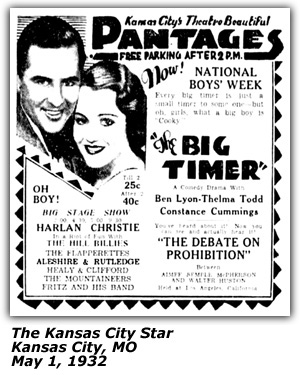  Lennie entertained quite a few different lines of employment through the years according to Ms. Tunnell. He worked at the Ascues Saddlery of Kansas City. He worked with a railroad for several years and could tune an engine as well as a violin. He would still go down to the rail yards and talk with the older engineers and firemen. He played professional baseball for three seasons, even after losing those three fingers. But eventually, he turned to the entertainment field. He joined up with McMae Hill and became a member of the company of professor Sage, who was a master magician and ventriloquist. He spent two years with the Cauble Brothers circus, traveling throughout the midwest. He worked with Dawes the Great - who was said to be Argentina's greatest wizard, and Lennie would say he was the best magician he ever saw. Lennie worked a lot in vaudeville, including as a tap dancer, even doing Indian dances as well. He traveled with Roy Wrightsman, who was a saxophonist from Springfield, Missouri, where they appeared in various Oklahoma theaters. Lennie was also hired on to work the Bert Levy circuit on the west coast.
Entertainer and Musician, Leonard Harrison "Lennie" Aleshire teamed up with Floyd Rutledge and joined the "Weaver Brothers and Elviry" vaudeville act in the 1920's as "Flash and Whistler". According to a 1946 article, he joined the Weaver Brothers show in 1928. It was this stint that led to him meeting Goo-Goo Rutledge and creating the act they would become known for. The duo were better known as "Lennie and Goo-Goo" and were admired by fans around the world. It was said that Lennie used that time to showcase many of his self-made musical instruments.
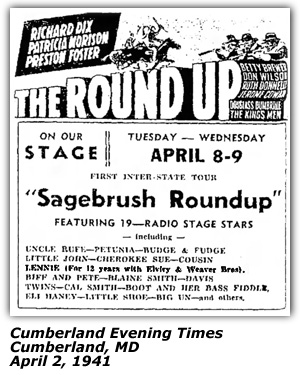 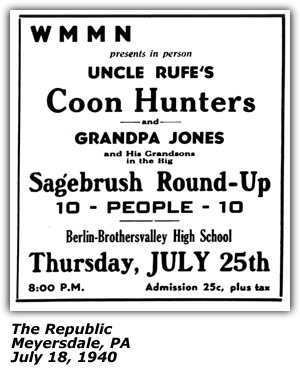 Then seeking work in radio he worked for several months with Hugh Cross and Shug Fisher's Radio Pals at WWVA in Wheeling in 1937. Later he went to WMMN Fairmont for both daily shows and the Sagebrush Roundup as part of Grandpa and his Grandsons. Jones, in his autobiography Everybody's Grandpa (1984), discussed some of Aleshire's unusual skills. He noted that he could make and play such unusual instruments as to string up a dresser drawer like a steel guitar, a one-string push broom that he played with a fiddle bow, partly filled bottles that he would tap on, and tie cowbells to his hands and feet and play tunes on them (Grandpa and wife Ramona learned this skill as well). He could also do fast tap dancing and skillfully square dance with imaginary partners.
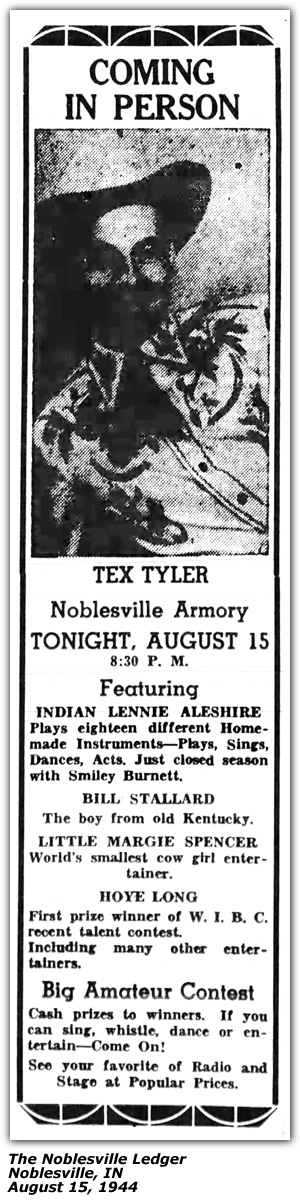
He also later worked at WLW in Cincinnati, Ohio. While he was at WWVA, he worked with Dale Parker, who was noted for his banjo recordings. He and Dale worked together as part of the Rhythm Rangers for about a year. Later, Dale and Lennie would join the KWTO staff in August of 1944(?). We question that year as the reprinted article wasn't dated and the 1946 reprint mentions that Lennie came back to KWTO in 1944.
  When Grandpa Jones broke up this band when he left Fairmont, Aleshire went back to the Missouri Ozarks and KWTO where he soon became part of the their popular program Korn's-a-Crackin' which ultimately became the forerunner of the Ozark Jubilee that in 1954 became the first prime-time country music network TV program. Back in Springfield, Aleshire teamed up with Floyd "Goo-Goo Rutledge"-with whom he had worked some before-as half of the comedy team of Lennie and Goo-Goo on the Ozark Jubilee. This kept him busy performing and touring until the program was cancelled in 1961. After that he pretty much retired. When his former boss Grandpa Jones appeared at the old-timer program at the 4th Annual Fan Fair in 1975 in Nashville, he introduced Lennie who was in the audience but he did not perform. As far as is known he never made any recordings. (Note: The reader can find some video clips of Lennie and Goo-Goo on the Ozark Jubilee show on youtube.com.) At the end of the 1940's he again worked with Grandpa Jones, this time on the Connie B. Gay programs at WARL in Arlington, Virginia and toured with him as far as Nova Scotia. Billboard magazine reported in February 1950 that Grandpa Jones' act was doing 50 one-nighters for International Harvester in five southeastern states that would run through the middle of March 1950. His group during this time included his wife, Ramona, Smitty Smith and Lenny Aleshire.
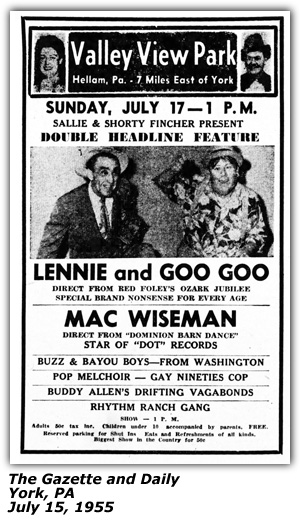 
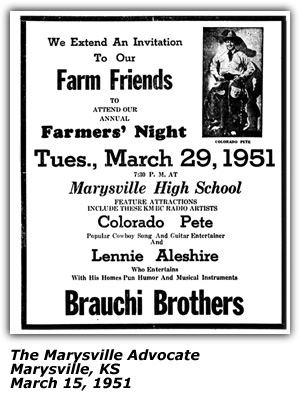 
 
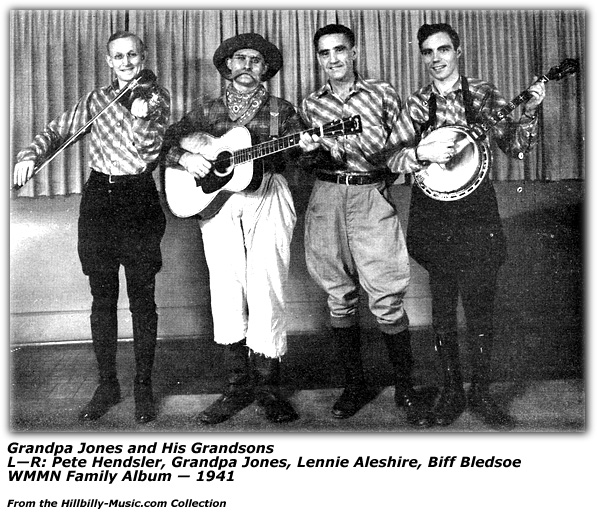
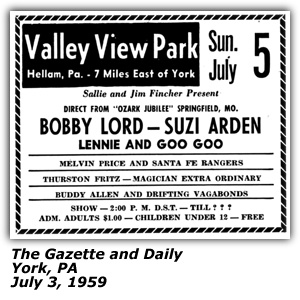 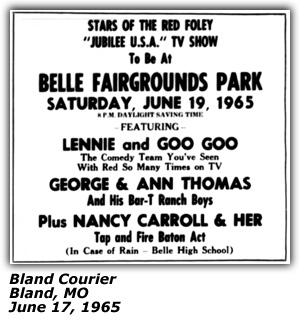 Today it would be unheard of to mention where an artist lived, for fear of the paparazzi tailing them, but the 1946 article notes that Lennie and his wife found a nice home on West Kearney Street in Springfield. Lennie and Goo-Goo were personal friends with Louis Marshall "Grandpa" Jones and worked with him on a radio show in West Virginia before returning to Springfield, Missouri. Ivan Tribe wrote in his book on country music history in West Virginia that Grandpa Jones came to WMMN in Fairmont in 1939 and formed an act called Grandpa Jones and his Grandsons. The Grandsons consisted of Lennie Aleshire, Loren (Biff) Bledsoe and Pete Rentschler. According to Mr. Tribe, Grandpa Jones stayed on the WMMN staff for a couple of years before moving back to Wheeling. Lennie and Goo-Goo enjoyed a good reputation. An article promoting their appearance at the St. Francois County Fair (Missouri) on August 30, 1963 revealed some insight. Red Foley was quoted as saying, "Nobody in Country Music dishes out bigger helpings of fun than Lennie and Goo-Goo." They had been with Red's Ozark Jubilee since the show began in 1955. Foley went on to say, "They get more music from bells tied to their hands and feet than you usually hear from an entire band!" Besides the bells, the two of them played just about every instrument one could hear of and a few one may not have. "Madcap musical shenanigans will be served up in big helpings when TV stars Lennie and Goo-Goo come to the fair. They're just what the doctor ordered for all-family fun." The Ozark Jubilee which later became "Country Music Jubilee" then "Jubilee USA" had a weekly viewing audience of 25 million people. In a 1947 issue of KWTO's "The Dial", we read in "The Spotlight" column a bit of a humorous road story of Lennie and Goo-Goo. It seemed during their summer tour one year, they were to drive from St. Joseph to Omaha one evening. Goo-Goo fell asleep before he could give Lennie any directions. When Goo-Goo woke up, the duo found they were two miles from the Minnesota state line and still just as far from Omaha as when they started the drive. The columnist wrote that it was similar experiences that led to the KWTO performers making sure Goo-Goo woke up in time to make the broadcasts. Lennie and Goo-Goo were pioneers that set the stage for what's known as "hillbilly music". They were famous for their comedy and musical talent by playing cow bells and their crude homemade instruments. Today, those instruments are on display in the Ralph Foster Museum at the College of the Ozarks in Hollister, Missouri. When the news of Floyd "Goo-Goo" Rutledge's passing was reported in October 1970, Lennie revealed some tidbits about their later appearances. He said, "We don't dance as swift as we used to, but we did go down to do a Porter Wagoner (TV) show. And there had been some talk recently about us being on Johnny Carson's tv show in New York, and then stopping in Philadelphia on the way back to do the Mike Douglas show. But, what Goo-Goo was most proud of was what he'd already done — played for four generations, he figured. And got some fine standing ovations." Due to the musical uniqueness of the cow bells, Grandpa Jones started using them in his act after he joined WSM's Grand Ole Opry in Nashville, Tennessee.
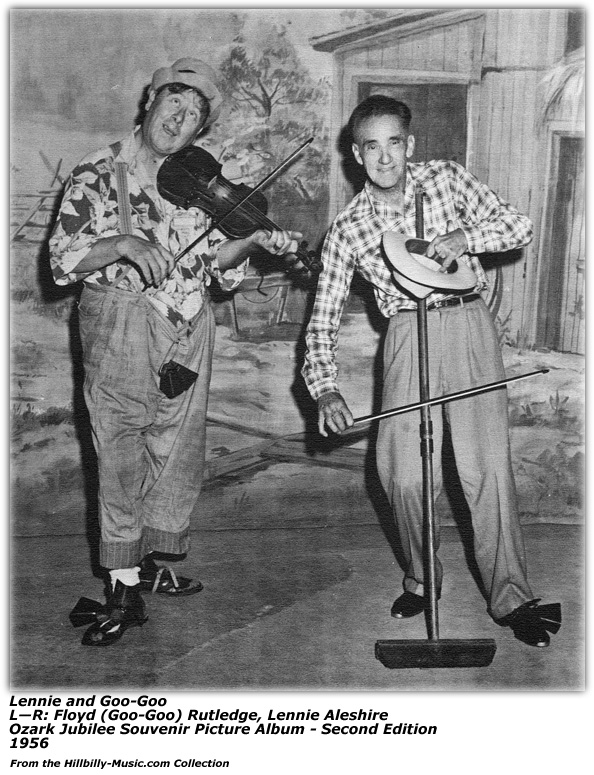
Porter Waggoner, Billy Walker, Leroy Van Dyke and Brenda Lee are among other Nashville country music recording artists that worked with Lennie and Goo-Goo during the Ozark Jubilee era, credit Lennie as a great showman, dancer, musician, that taught them about stage presence. Lennie told Mable Tunnell in an article she wrote for the Greenfield Vedette that he had a motto, "Smile and the world smiles with you" and tried to leave everyone with a smile. Lennie passed away at the age of 97. A simple three paragraph obituary was published in the Springfield newspaper. The only mention of his career was that he was a "retired musician." He had been in the Springfield Health Care Center dealing a long illness at the time of his death. Credits & Sources
|
| Printer Friendly Version |
Hillbilly-Music.com
Yes, Hillbilly Music. You may perhaps wonder why. You may even snicker. But trust us, soon your feet will start tappin' and before you know it, you'll be comin' back for more...Hillbilly Music.
Hillbilly-music.com ...
It's about the people, the music, the history.
|
Copyright © 2000—2023 Hillbilly-Music.com
|
||||
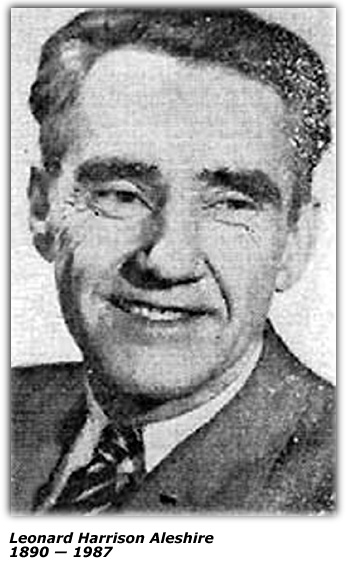 Leonard Harrison Aleshire was born in Christian County, Missouri in the town
of Sparta. He spent most of his young life in Dade County. Lennie's grandmother
was one-half cherokee Indian and his grandfather was an Englishman. He was
proud of his heritage.
Leonard Harrison Aleshire was born in Christian County, Missouri in the town
of Sparta. He spent most of his young life in Dade County. Lennie's grandmother
was one-half cherokee Indian and his grandfather was an Englishman. He was
proud of his heritage.
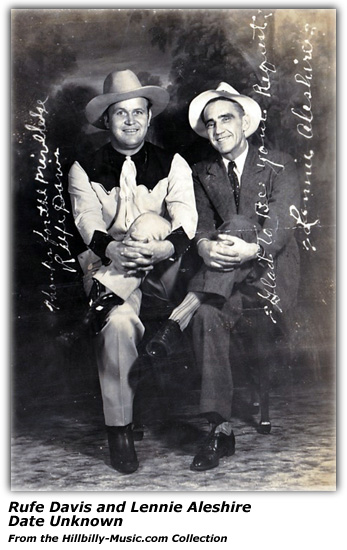 When he was 15 years old, he made his home with the Creek Indians near Broken Arrow,
Oklahoma. The article we learn this from doesn't explain why he was living with
the tribe then, perhaps already leaving his parents to make his way in the world.
He became well versed in their ways and customs and could speak their language
fluently. He even did lectures back east about the customs and history of the Indians.
When he was 15 years old, he made his home with the Creek Indians near Broken Arrow,
Oklahoma. The article we learn this from doesn't explain why he was living with
the tribe then, perhaps already leaving his parents to make his way in the world.
He became well versed in their ways and customs and could speak their language
fluently. He even did lectures back east about the customs and history of the Indians.
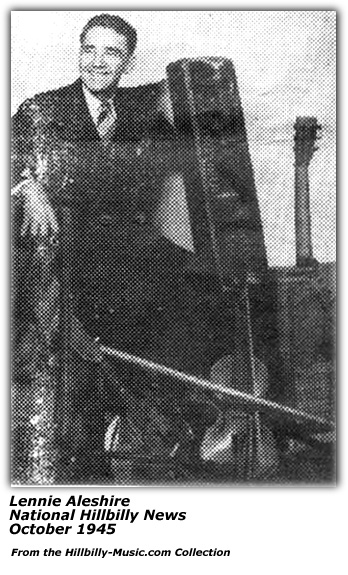 During this early time of his career, L. T. Dunaway and Tom O'Connell had a silent
movie at the Sky Dome in Dadeville. The Aleshire Trio put together their first
show there in vaudeville. Lennie was always the blackface boy.
During this early time of his career, L. T. Dunaway and Tom O'Connell had a silent
movie at the Sky Dome in Dadeville. The Aleshire Trio put together their first
show there in vaudeville. Lennie was always the blackface boy.